Hawaii Public Radio · 1993–1998
Price of Paradise Recordings and Commentaries
Hawaii Public Radio broadcast Price of Paradise from 1993 to 1998. Susie Roth produced and Randall Roth hosted almost all of the 220 broadcasts, bringing legislators, judges, scholars, executives and activists into the same hour to argue Hawaii’s hardest questions. Every broadcast below plays as a single complete recording, with a written summary and a full transcript. Episodes are being added as they are prepared.
-
Balancing Individual Rights with Community Interests
A proposed special district ordinance for Manoa Valley in Honolulu provided the focal point for a broader discussion of when community interests may legitimately constrain what property owners do with their own land. John Whalen and Don Clegg, both former directors of the Department of Land Utilization for the City and County of Honolulu, brought differing emphases to the question. Whalen, who had been directly involved in drafting the Manoa proposal, argued that neighbourhood-scale planning standards could be tailored to fit the existing character of older areas without unduly burdening individual owners; the ordinance would restrict building size and placement, the removal of mature trees, and the paving over of yards. Clegg acknowledged the value of community input but cautioned that special districts can end up protecting interests — such as favoured view planes — that are personal rather than genuinely communal. Both agreed that the process required careful balance between participation and constraint. The standing question is whether Honolulu's zoning law should allow neighbourhoods to adopt tailored restrictions that go beyond standard citywide rules, and who bears the cost when such rules reduce what an owner may do with private property.
Transcript
Read or download the full transcript (.txt). Speaker labels were assigned automatically and may contain errors.
Companion newspaper commentaries
Commentaries by the guests, published in The Honolulu Advertiser around the broadcast.
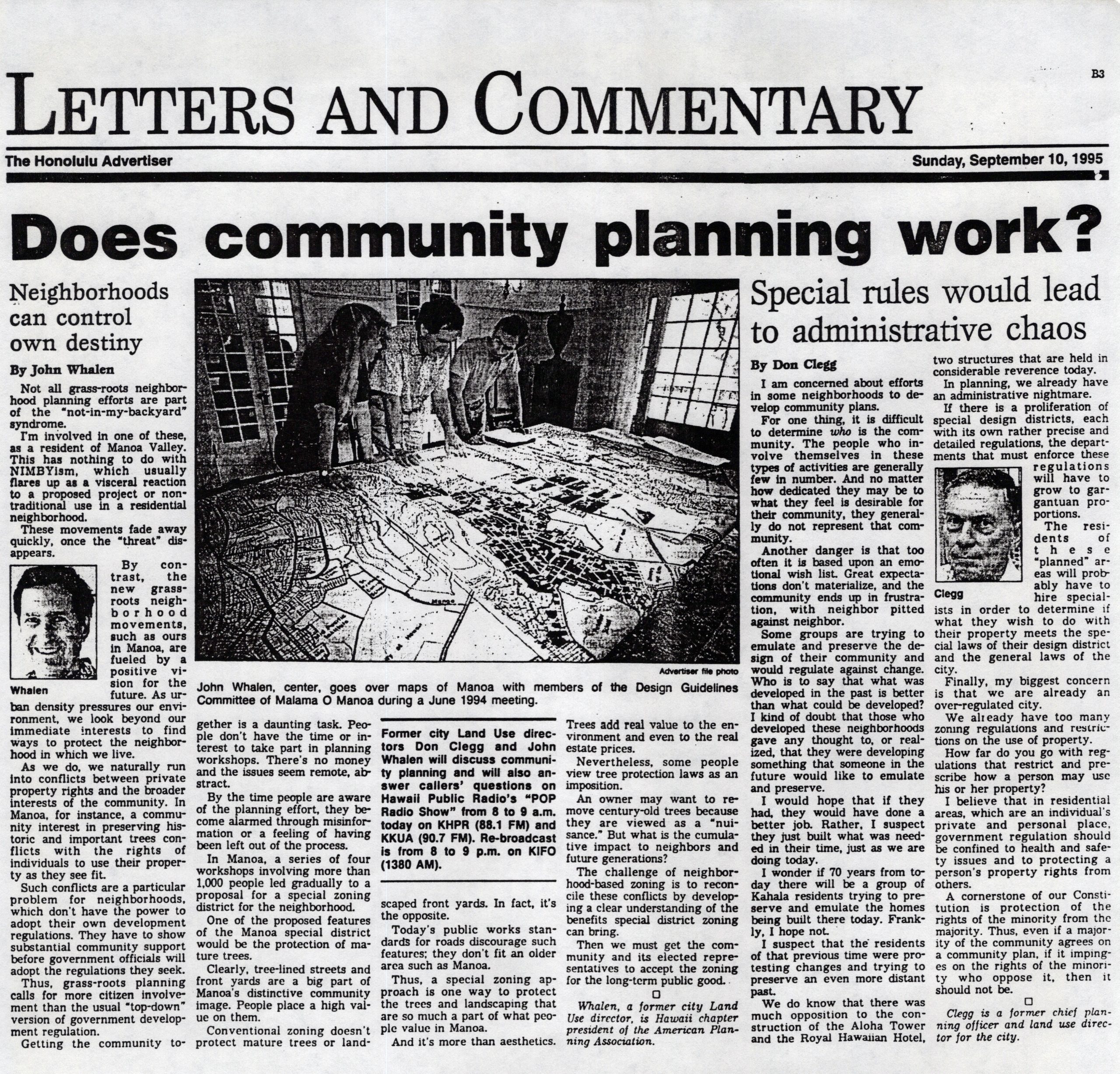
Companion commentary 1 of 1 — click to open full size -
Land Use in Hawaii
Hawaii faced a pressing question about what would happen to roughly 177,000 acres of land leaving sugar and pineapple production. Peter Garrod, Professor of Agricultural and Resource Economics at the University of Hawaii, argued that the sugar industry's decline was irreversible, that pineapple could not expand to fill the gap, and that diversified agriculture faced too many structural barriers — high production costs, distance from mainland markets, and pest restrictions — to absorb more than a small fraction of the acreage. Francis Oda, chairman and chief executive of Group 70 International, proposed mixed-use agricultural villages in which a small portion of former plantation land would be zoned for housing, with the remainder dedicated in perpetuity to agriculture and linked to small-scale eco-cultural tourism, on the model of working guest ranches he had seen succeed in Wyoming. Garrod was sceptical that free land alone would make small farms viable, though he acknowledged the approach might yield some modest expansion. Both guests agreed that existing state and county law prohibited the kind of integrated housing, agriculture, and tourism arrangement Oda described, and that changes in both statutes and public attitudes would be necessary before any such plan could move forward.
Transcript
Read or download the full transcript (.txt). Speaker labels were assigned automatically and may contain errors.
-
Water War in Hawaii
Hawaii's water resources, long taken for granted by residents, are more limited than commonly assumed, and the state faces binding choices about who receives priority when demand exceeds supply. Dick Cox, an engineering consultant and former member of the State Commission on Water Resource Management, described how the 1987 water code created the commission and assigned it authority to issue use permits in designated management areas, adjudicating among competing claims from urban development, agriculture, and holders of native Hawaiian water rights — including appurtenant rights tied to taro cultivation practices that predate the 1848 Great Mahele. Michael Chun, president of Kamehameha Schools and also a former commission member, stressed that public understanding of conservation remained inadequate and that generational effort in education would be necessary. Both guests discussed golf courses as a contested case, with both prepared to treat them as a form of agricultural water use provided management practices limited runoff into groundwater. The standing question is how the Water Commission should rank competing claims — from native Hawaiian rights, agricultural users, and urban development — when the available resource cannot satisfy all of them, and whether current public education efforts are sufficient to encourage meaningful conservation.
Transcript
Read or download the full transcript (.txt). Speaker labels were assigned automatically and may contain errors.
-
Hawaii’s Environment
Topic: Environment & EnergyTwo contrasting images of Hawaii's environment — pristine beaches versus the sewage spills and incinerator emissions making headlines — framed a discussion about the adequacy of state environmental oversight. Guest host Bruce Voss led the conversation against the backdrop of a 1994 gubernatorial race in which both guests said environmental issues had received less attention than education, crime, and the cost of living. Bruce Anderson, at the time Deputy Director for Environmental Health at the State Department of Health, argued that measurable progress had been made: he described a new programme to collect household hazardous waste and a glass-container fee to subsidise recycling and reduce groundwater contamination. Susan Miller, an environmental consultant working with the Hawaii Coastal Protection Project, placed greater emphasis on non-point source pollution — runoff carrying soil, fertilisers, and other contaminants from disturbed hillsides and urban surfaces into coastal waters. Miller also defended retaining the State Land Use Commission as a check on county-level development, noting that counties' reliance on property-tax revenue creates incentives to permit growth. The standing question is whether the existing framework of state and county oversight can manage dispersed sources of pollution before further damage is done to Hawaii's coastal resources.
Transcript
Read or download the full transcript (.txt). Speaker labels were assigned automatically and may contain errors.
-
Judicial Selection
Hawaii's system of selecting state judges through a Judicial Selection Commission, created after the 1978 constitutional convention to replace direct gubernatorial appointment, came under scrutiny from several directions. Jim Koshiba, a practicing attorney who chaired the commission during its first six years, argued for greater transparency, including public ranking of nominees and an open process for selecting commissioners. Momi Cazimero, who served on the commission from 1983 to 1989, described a broadly constructive experience but noted tensions between confidentiality and public accountability. Senior U.S. District Court Judge Samuel P. King offered observations from the perspective of a federal court. By telephone, retired Hawaii Supreme Court Justice Frank Padgett proposed removing all lawyers from the commission to eliminate conflicts of interest, with the commission consulting the bar association separately on professional qualifications. Ellen Colburn, a former commission member from 1989 to 1995, called for more rigorous commissioner selection based on independence and judgment, arguing lay members offered a counterweight to attorneys trained in advocacy. The standing question is whether the commission's processes — its composition, the confidentiality of deliberations, and the appointing authority's latitude when choosing from an unranked list — deliver genuine merit selection or leave room for political influence.
Transcript
Read or download the full transcript (.txt). Speaker labels were assigned automatically and may contain errors.
Companion newspaper commentaries
Commentaries by the guests, published in The Honolulu Advertiser around the broadcast.
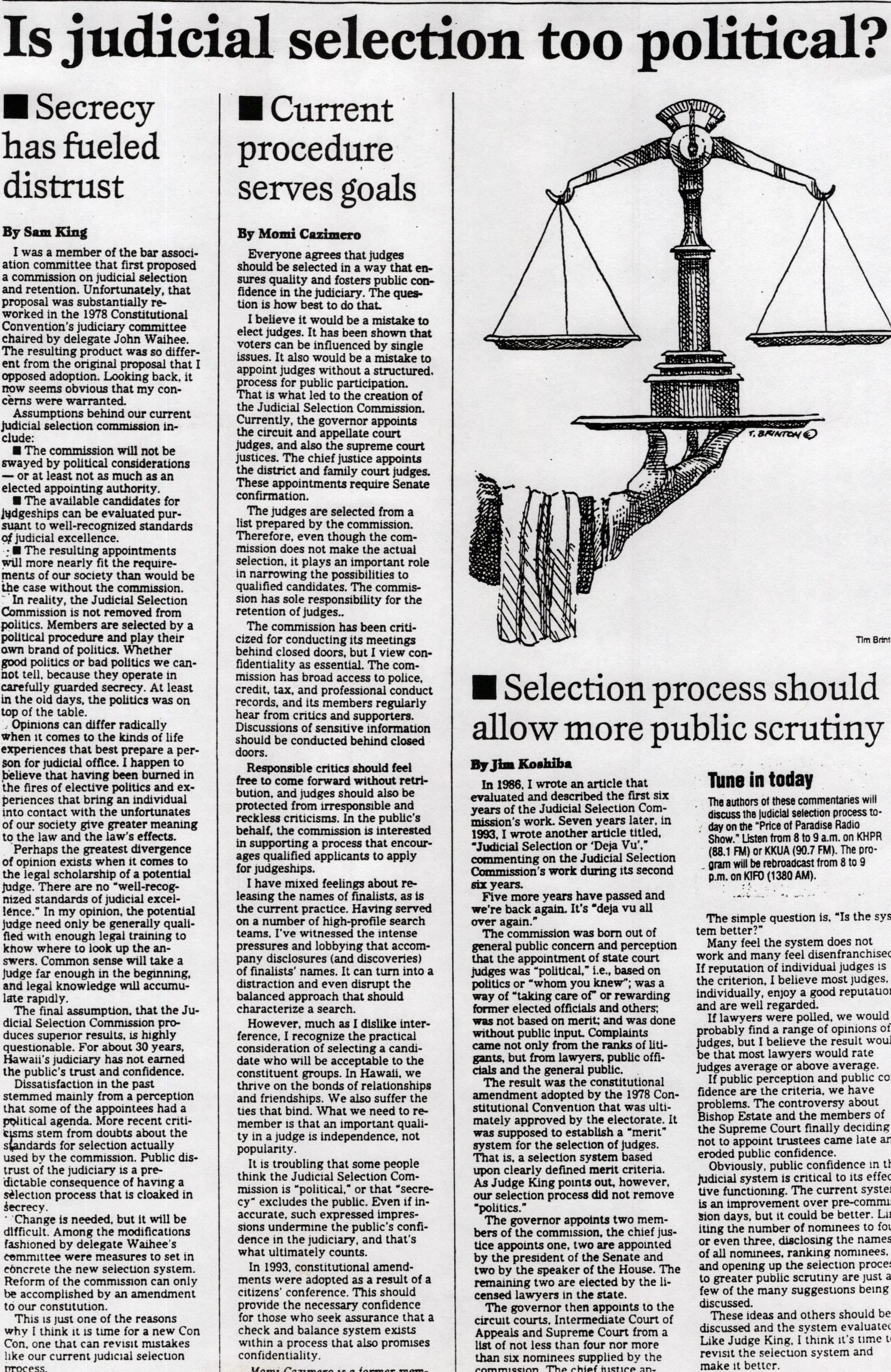
Companion commentary 1 of 3 — click to open full size 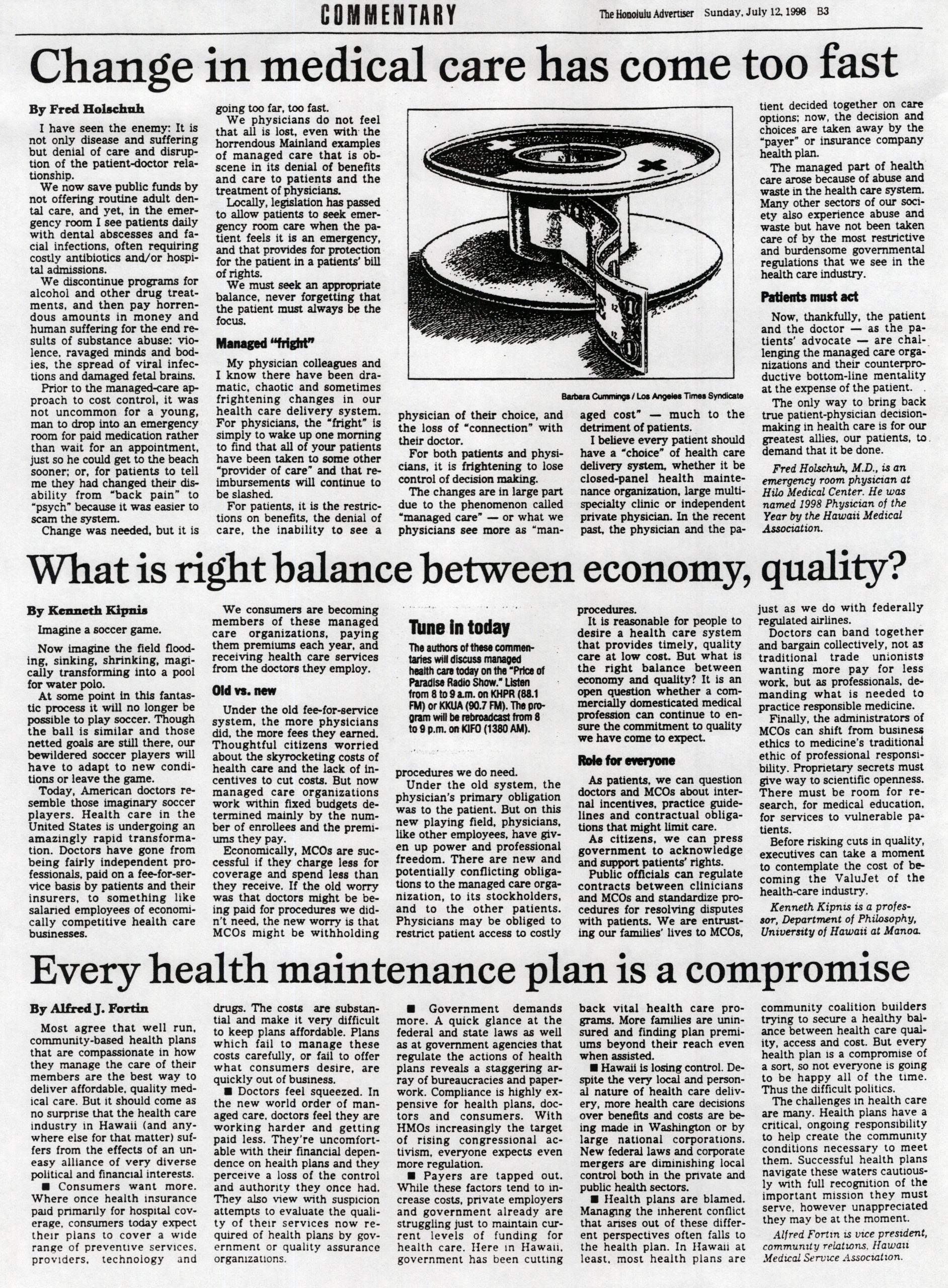
Companion commentary 2 of 3 — click to open full size 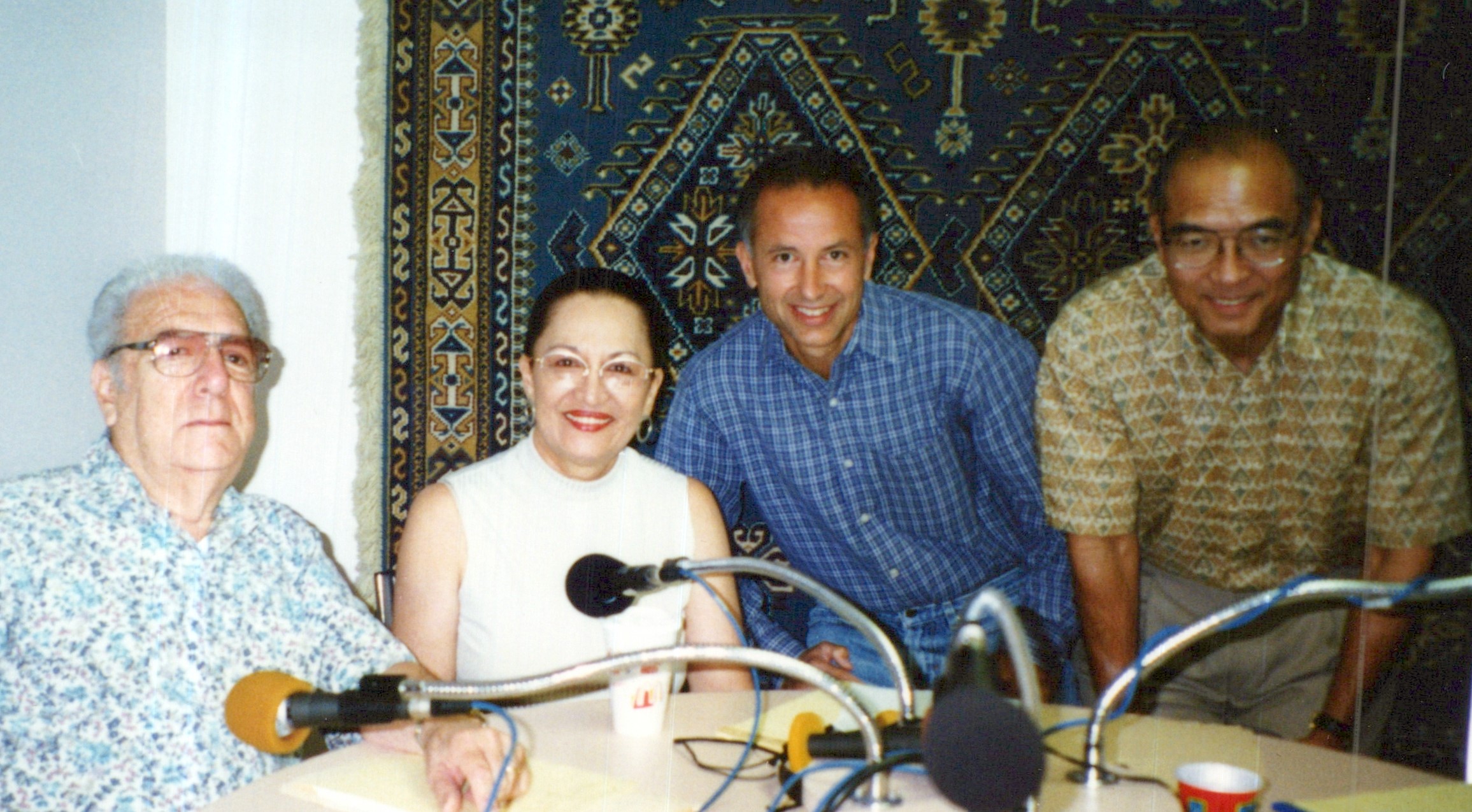
Companion commentary 3 of 3 — click to open full size -
Judicial Independence
Topic: Law & the CourtsRonald Moon, Chief Justice of the Hawaii Supreme Court, and Michael Town, a Circuit Court Judge, joined host Randall Roth to address the meaning and importance of judicial independence in Hawaii's system of government. Moon argued that judges must be free to decide cases solely on their legal merits, without fear of reprisals from legislators, interest groups, or public opinion polls—a principle he said was undermined by criticism he characterized as factually inaccurate, including allegations that the Supreme Court acted at the direction of a union official. Town described the deliberative process of judging as grounded in law, procedure, and fact, not public reaction. Both guests discussed mechanisms for judicial accountability, including the Judicial Selection Commission's retention process, performance evaluations by attorneys, and the Judicial Conduct Commission. The conversation also covered the judiciary's eight-year pay freeze, which Moon said had created a distracting and potentially compromising dynamic with the legislature. The central question remains how Hawaii can balance the need for judicial independence against the public's legitimate interest in holding judges accountable.
Transcript
Read or download the full transcript (.txt). Speaker labels were assigned automatically and may contain errors.
Companion newspaper commentaries
Commentaries by the guests, published in The Honolulu Advertiser around the broadcast.
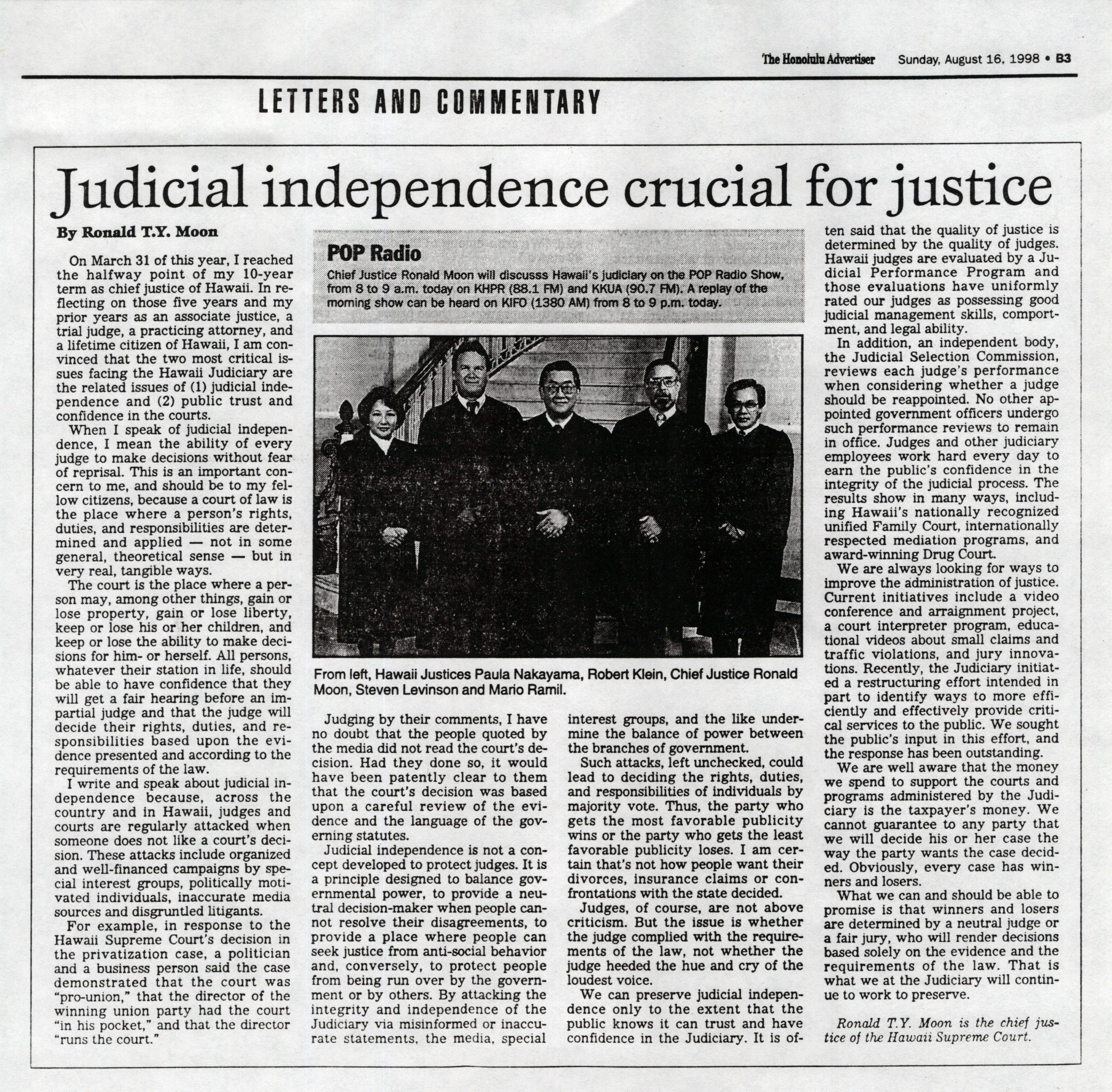
Companion commentary 1 of 2 — click to open full size Companion commentary 2 of 2 — click to open full size -
Justice on Trial: O.J
Topic: Law & the CourtsThe acquittal of O.J. Simpson prompted this episode's examination of whether the American jury system is fundamentally sound. Samuel P. King, a Federal District Court Judge, and Jackie Earle, a civil trial attorney, both maintained that the jury likely followed its instructions and applied the rules of evidence correctly, given that the information it received differed substantially from what media audiences saw. King invoked John Adams on the jury as a constitutional guarantor of liberty, while Earle explained how evidence presented to the jury carried different weight than the same material filtered through television commentators. Criminal trial attorney Nick Garcia, the head of the local Criminal Trial Lawyers Association, called in to argue that jury verdicts reflect the communities that produce them, and that racial polarization in Los Angeles—not a flaw in the jury system itself—explained the verdicts in the Simpson, Rodney King, and Reginald Denny cases. The central question is whether the jury system requires reform, or whether it accurately mirrors the divisions of the society it serves.
Transcript
Read or download the full transcript (.txt). Speaker labels were assigned automatically and may contain errors.
Companion newspaper commentaries
Commentaries by the guests, published in The Honolulu Advertiser around the broadcast.
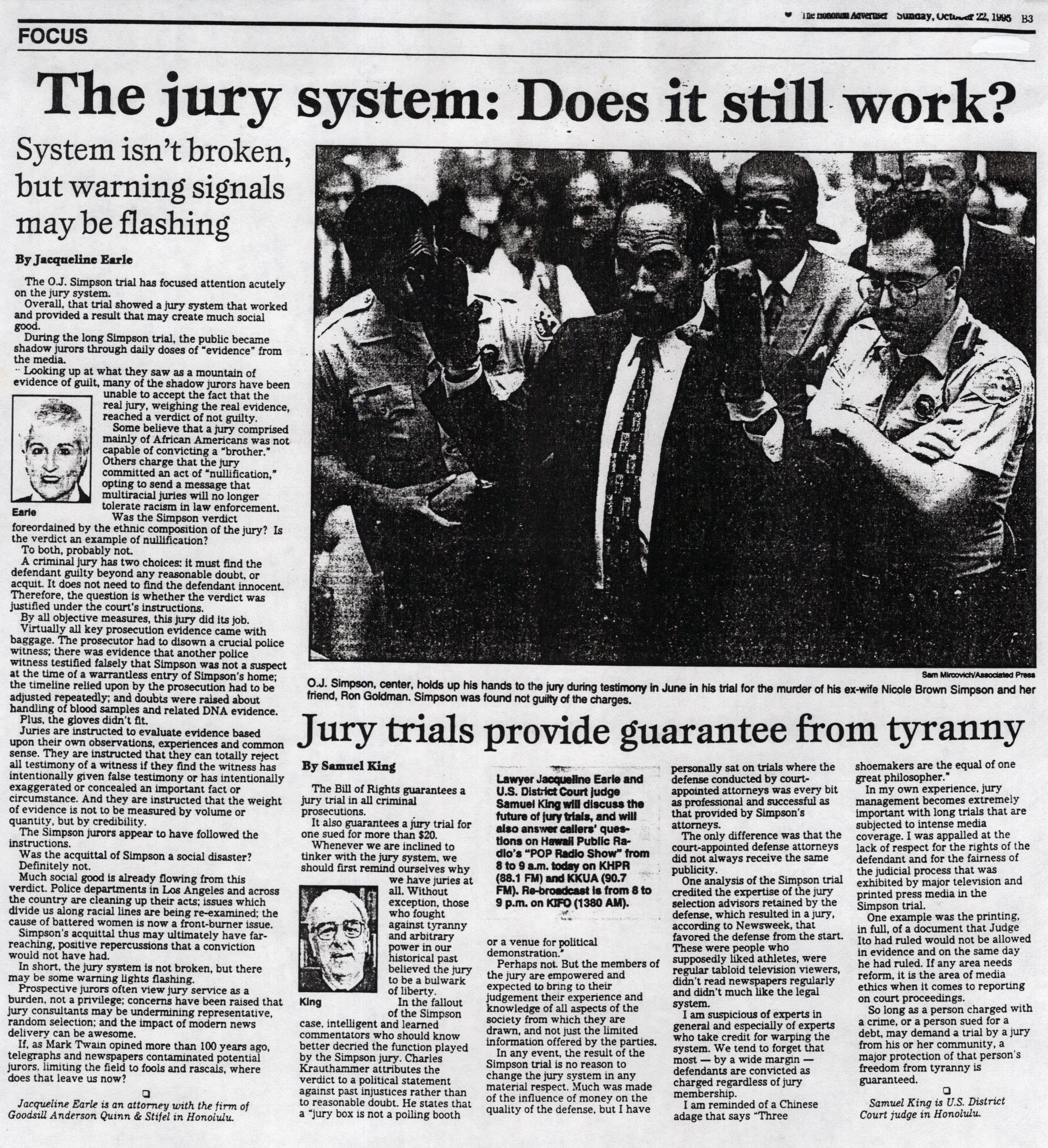
Companion commentary 1 of 1 — click to open full size -
Candidates for Prosecutor on Hawaii’s Criminal Justice System
Three candidates for the position of Honolulu Prosecuting Attorney—David Arakawa, Peter B. Carlisle, and Randal Yoshida, each a former supervising deputy prosecutor—presented their approaches to Hawaii's criminal justice system in a recorded forum hosted by Randall Roth. All three identified drugs and repeat offenders as primary drivers of rising crime, but differed on methods and priorities. Arakawa stressed prison overcrowding as the central constraint and called for a multi-pronged approach combining prosecution, rehabilitation, and community engagement. Carlisle cited his record leading the Oahu Career Criminal Unit, during which felonies fell by roughly 17,000 over five years, and argued that a prosecutor must lead by example in the courtroom. Yoshida emphasized administrative capacity and a plan to target major drug distributors with elite teams of prosecutors and police. All three addressed domestic violence, juvenile crime, the no-drop prosecution policy, and the death penalty, on which each expressed qualified support in limited circumstances. The question put to voters was which combination of trial experience and administrative skill best equips a prosecutor to lead a large public office during a period of rising violent crime.
Transcript
Read or download the full transcript (.txt). Speaker labels were assigned automatically and may contain errors.
Companion newspaper commentaries
Commentaries by the guests, published in The Honolulu Advertiser around the broadcast.
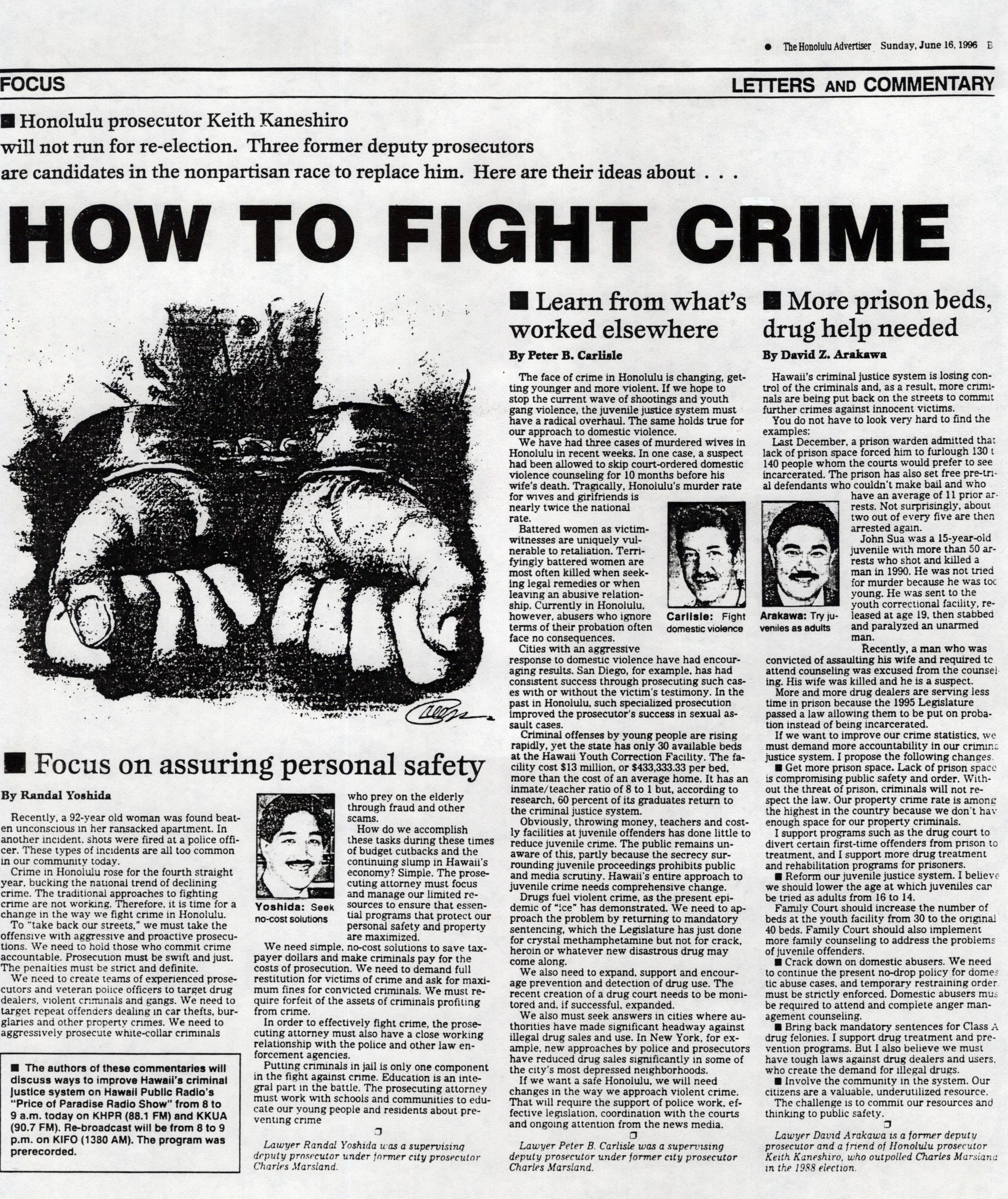
Companion commentary 1 of 1 — click to open full size -
Abortion
Twenty-three years after Roe v. Wade established a constitutional right to abortion, Holly Born, Associate Director of Hawaii Right to Life, and Eve Anderson, a Republican member of the Hawaii state legislature, discussed with host Randall Roth whether that right should be preserved, restricted, or ended. Born argued that abortion ends a human life—a human rights violation, not merely a religious question—and that adoption rather than abortion should be the response to unwanted pregnancy; she expressed qualified support for exceptions when a mother's life is at risk. Anderson, describing herself as pro-choice, favored access limited to the first trimester and opposed overturning Roe v. Wade, though she objected to including an anti-abortion plank in the Republican Party platform. Both guests agreed on the importance of education about personal responsibility and expressed skepticism about distributing condoms in schools. The question at issue is whether abortion should remain a legally protected individual decision or be curtailed as a matter of collective human-rights obligation.
Transcript
Read or download the full transcript (.txt). Speaker labels were assigned automatically and may contain errors.
Companion newspaper commentaries
Commentaries by the guests, published in The Honolulu Advertiser around the broadcast.
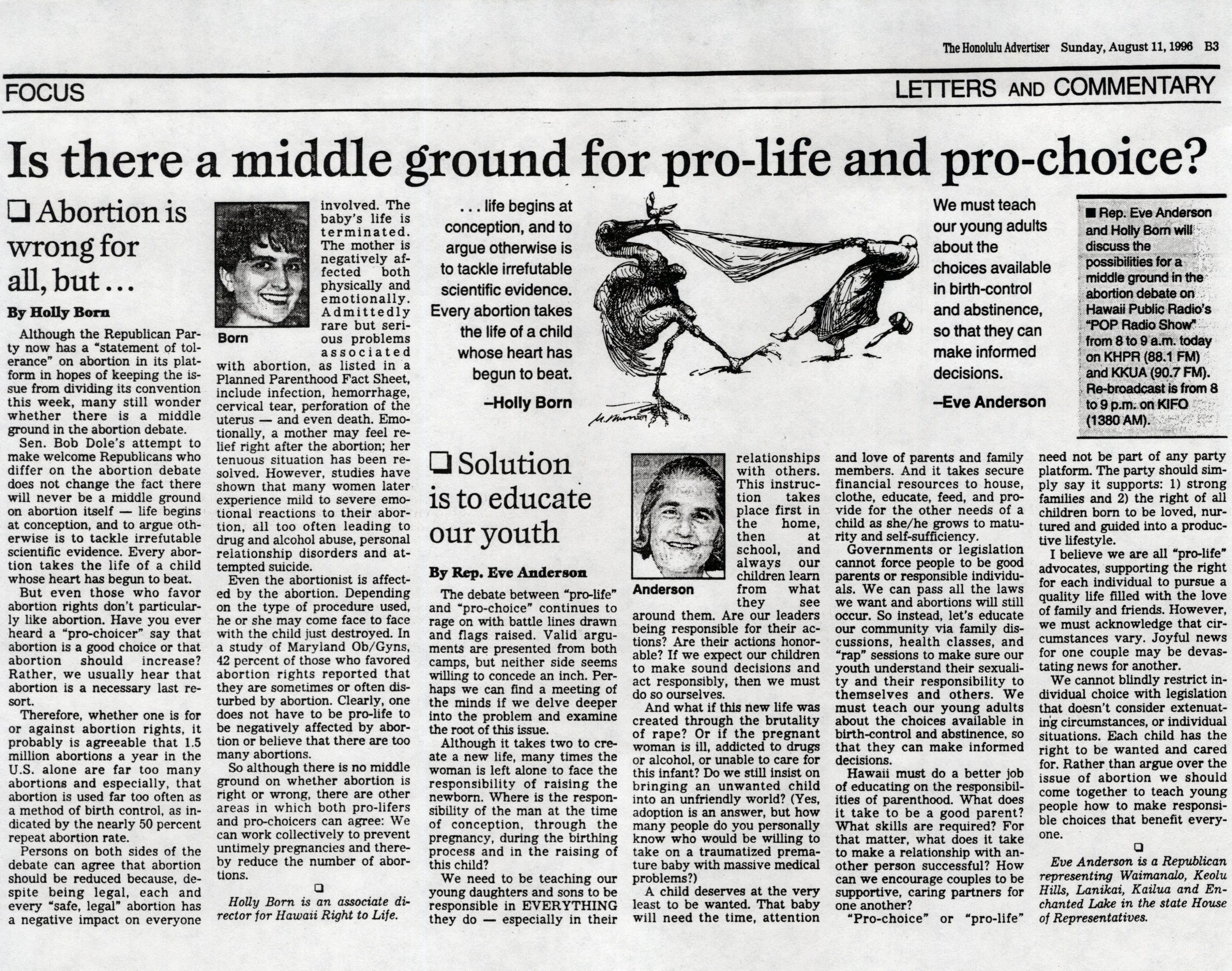
Companion commentary 1 of 1 — click to open full size -
Physician-assisted suicide
S.Y. Tan and Norman Goldstein, both professors at the University of Hawaii John A. Burns School of Medicine, discussed with host Randall Roth where the physician's duty to dying patients should end. Both guests supported hospice care and living wills as means by which patients can ensure they receive comfort rather than unwanted intervention at life's end. Their disagreement centered on physician-assisted suicide: Goldstein, who identified with the Hemlock Society, argued that physicians should be able to take a more active role in helping terminally ill patients end their lives when requested. Tan, who also holds a law degree and chairs a hospital ethics committee, contended that legalizing active mercy killing would erode trust in living wills, expose vulnerable patients to abuse, and risk the pattern documented in the Netherlands, where an estimated thousand people were euthanized without having explicitly consented. Bud Smiser, a columnist and former editor of the Honolulu Star-Bulletin, called in to urge families to discuss end-of-life wishes before any crisis arose. Kenneth Fifer, a minister from Ann Arbor, Michigan, described accompanying a patient through a Kevorkian-assisted death and argued that suffering beyond physical pain could justify physician assistance.
Transcript
Read or download the full transcript (.txt). Speaker labels were assigned automatically and may contain errors.
Companion newspaper commentaries
Commentaries by the guests, published in The Honolulu Advertiser around the broadcast.
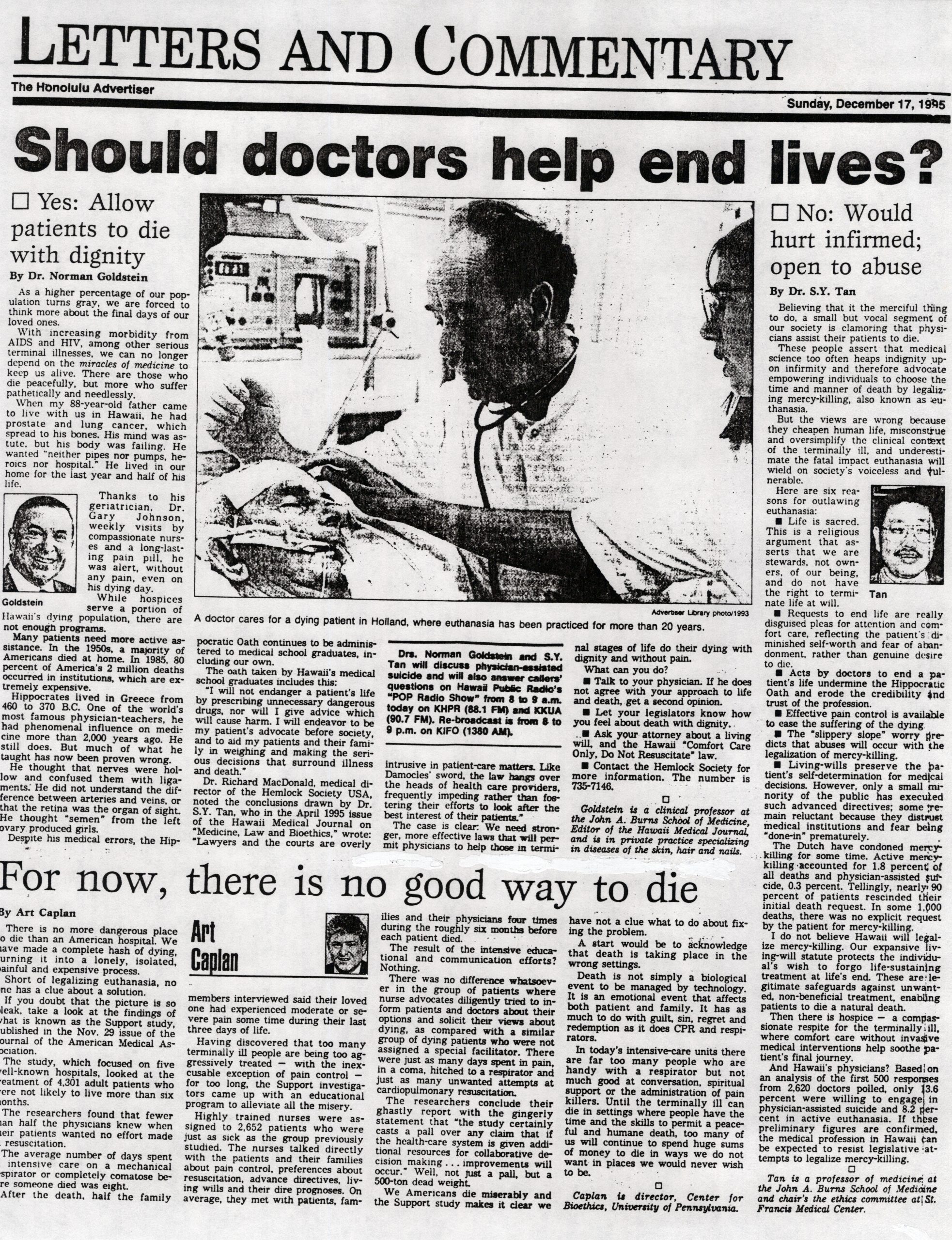
Companion commentary 1 of 1 — click to open full size