Hawaii Public Radio · 1993–1998
Price of Paradise Recordings and Commentaries
Hawaii Public Radio broadcast Price of Paradise from 1993 to 1998. Susie Roth produced and Randall Roth hosted almost all of the 220 broadcasts, bringing legislators, judges, scholars, executives and activists into the same hour to argue Hawaii’s hardest questions. Every broadcast below plays as a single complete recording, with a written summary and a full transcript. Episodes are being added as they are prepared.
Labor Unions in Hawaii
Sam Slom, a state senator and president of Small Business Hawaii, and Ah Quon McElrath, a labor activist and University of Hawaii regent, debated the role of unions in Hawaii's economy and political life. The concrete question at issue is whether Hawaii's strong union presence has harmed or protected the state's economic prospects and working families. Slom argued that public employee unions, in particular, have driven up the cost of government, suppressed private enterprise, and contributed to the decline of the sugar and pineapple industries by demanding wages and benefits that made agriculture uncompetitive. He contended that unions exercise political influence disproportionate to their membership, shaping legislation to the detriment of small businesses and taxpayers. McElrath disputed this account, maintaining that external forces—global trade policies, corporate decisions, and the inherent disadvantages of island geography—were primarily responsible for Hawaii's economic difficulties. She held that unions remain the only effective vehicle through which workers can exercise collective power over their conditions, and that without them, workers would be returned to the exploitation of the plantation era.
Transcript
Read or download the full transcript (.txt). Speaker labels were assigned automatically and may contain errors.
Companion newspaper commentaries
Commentaries by the guests, published in The Honolulu Advertiser around the broadcast.
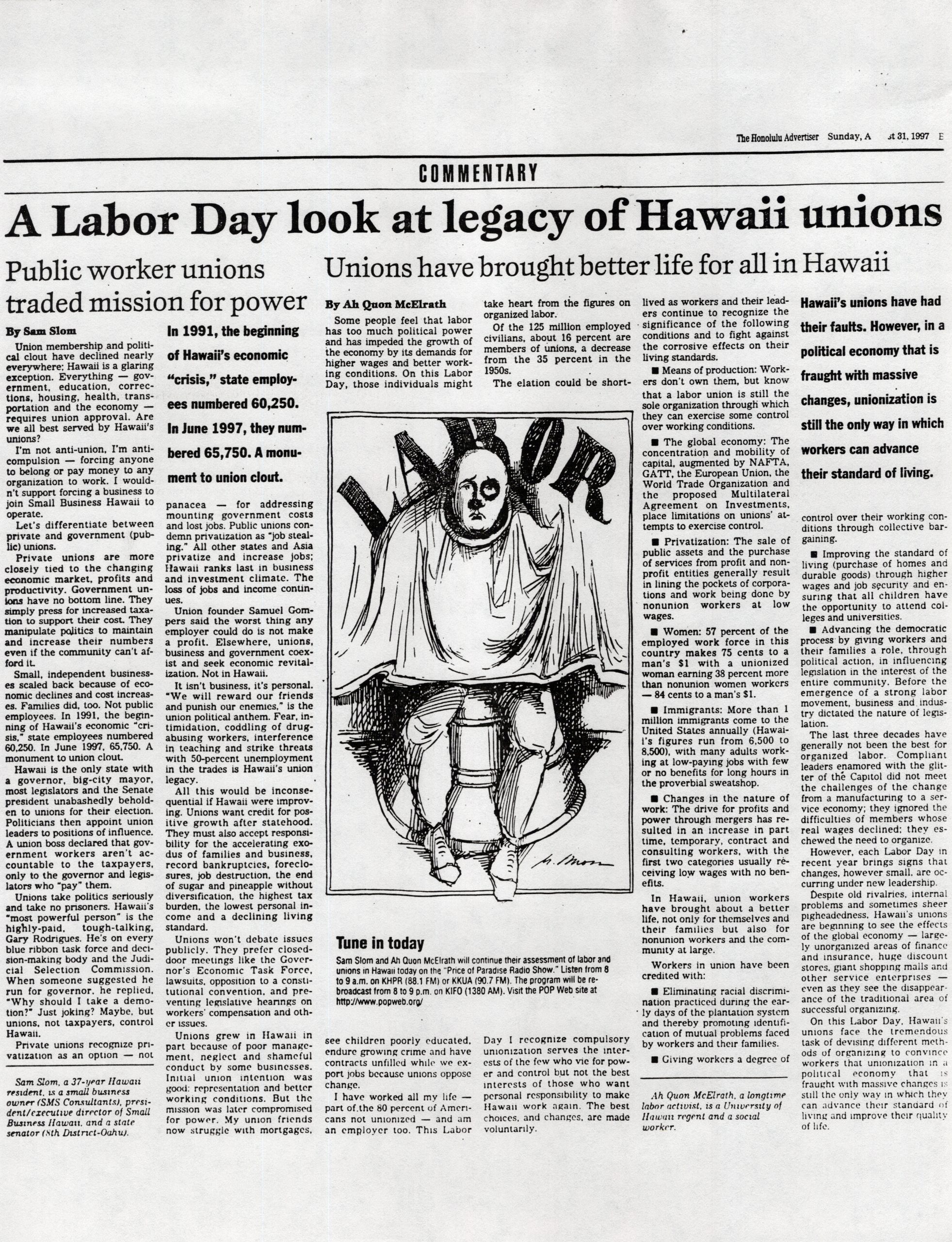
Companion commentary 1 of 1 — click to open full size Labor Unions in Hawaii
Topic: Economy & TaxesRecorded during an active HGEA strike, this call-in episode brought together three guests to discuss the strengths and vulnerabilities of Hawaii's labor union movement. J.N. Musto, executive director of the University of Hawaii Professional Assembly, Tony Rutledge, financial secretary of HERE Local 5, and Bill Puette, director of the UH Center for Labor Education and Research, all offered broadly pro-union perspectives while differing on specific points of law and strategy. The concrete question at issue is whether Hawaii's public sector collective bargaining law gives workers meaningful recourse against a state employer that consistently rejects fact-finder recommendations and refuses binding arbitration. Musto argued that the state has never once accepted a fact-finder's report in the history of Chapter 89 bargaining, leaving unions with no neutral forum for resolving disputes. Rutledge emphasized the historical role unions played in raising workers' living standards, while Puette added comparative context, noting that unions raise wages relative to non-union workers and that the state actually saves money while employees are on strike by not paying their salaries.
Transcript
Read or download the full transcript (.txt). Speaker labels were assigned automatically and may contain errors.
Who Runs the University of Hawaii?
David Yount, a physicist, longtime University of Hawaii professor and administrator, appeared to discuss his newly published book on UH governance. Stuart Ho, a University of Hawaii regent, joined the conversation to assess Yount's findings. The concrete question the episode turns on is who actually controls the University of Hawaii, and whether that ambiguity has prevented the institution from achieving excellence. Yount argued that Hawaii's state constitution creates an unresolved tension between the Board of Regents and the legislature: the board is nominally responsible for running the university, yet the legislature controls the purse strings and frequently intervenes in academic matters. This divided authority produces a power vacuum, delayed decisions, and the loss of star faculty. Ho, drawing on his own experience as a regent thirty years earlier, largely confirmed Yount's analysis and said the problems described in the book were already present in his day. Both agreed the state had not made a genuine commitment to building a world-class university, though they differed on whether abolishing the Board of Regents might clarify accountability.
Transcript
Read or download the full transcript (.txt). Speaker labels were assigned automatically and may contain errors.
Companion newspaper commentaries
Commentaries by the guests, published in The Honolulu Advertiser around the broadcast.
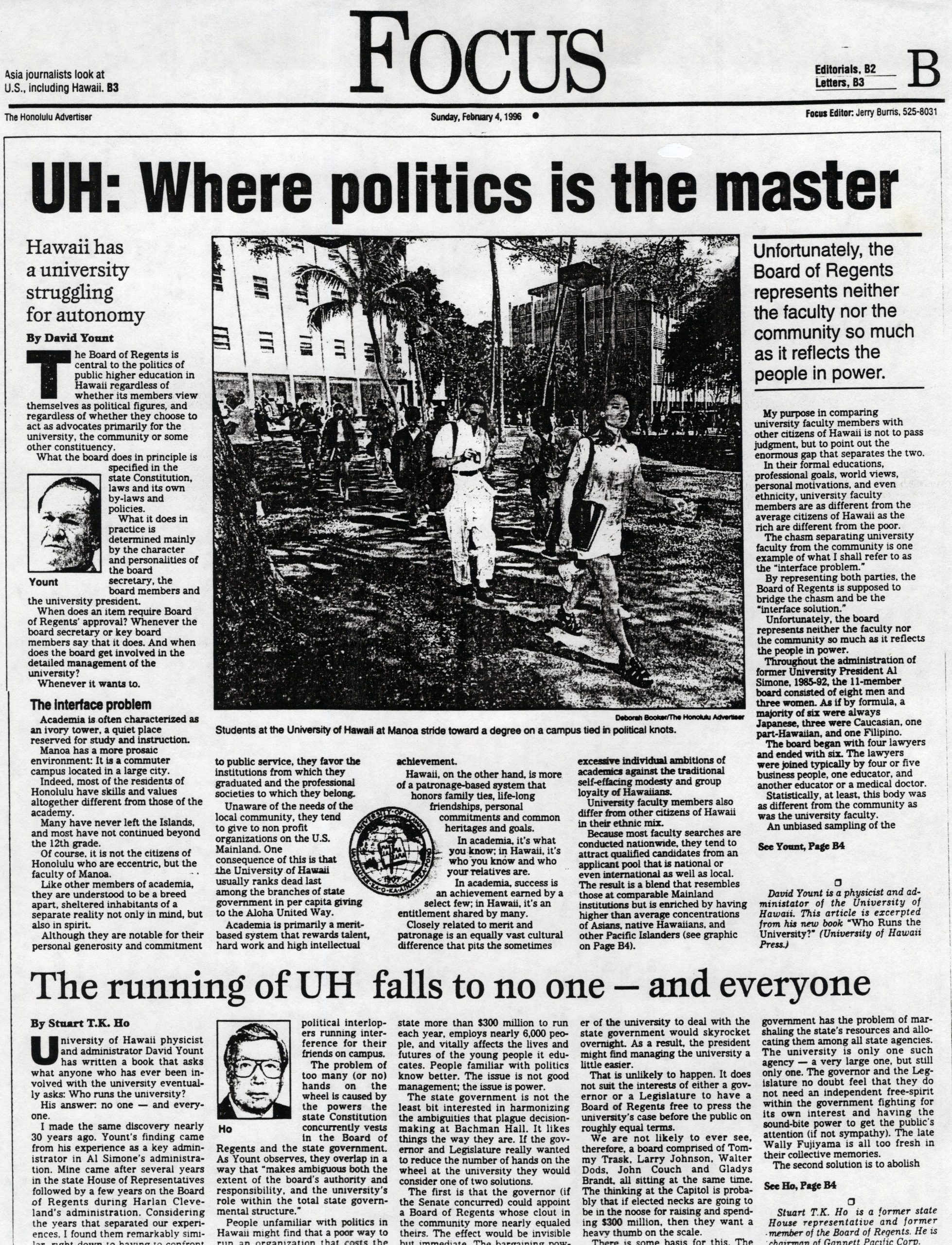
Companion commentary 1 of 3 — click to open full size 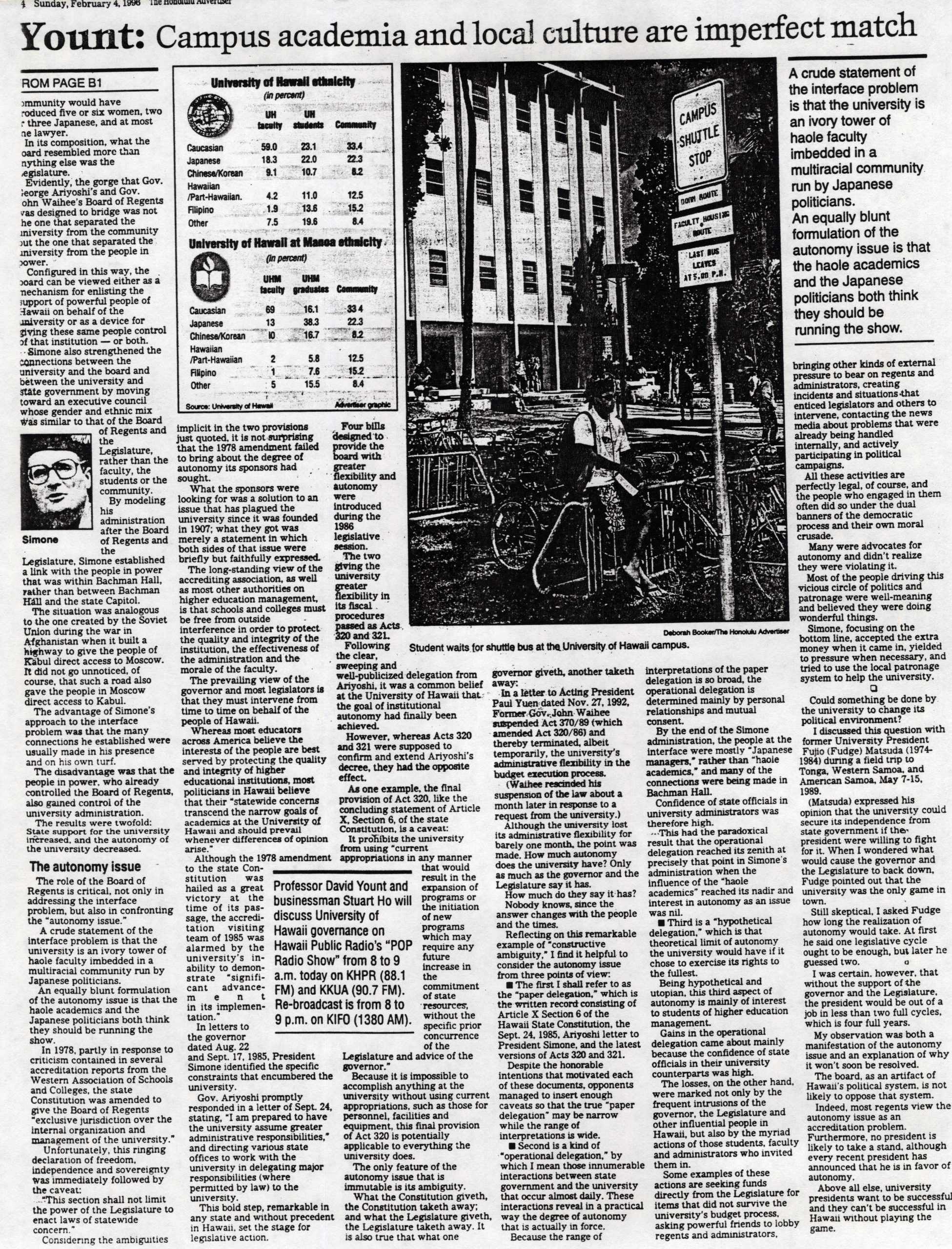
Companion commentary 2 of 3 — click to open full size 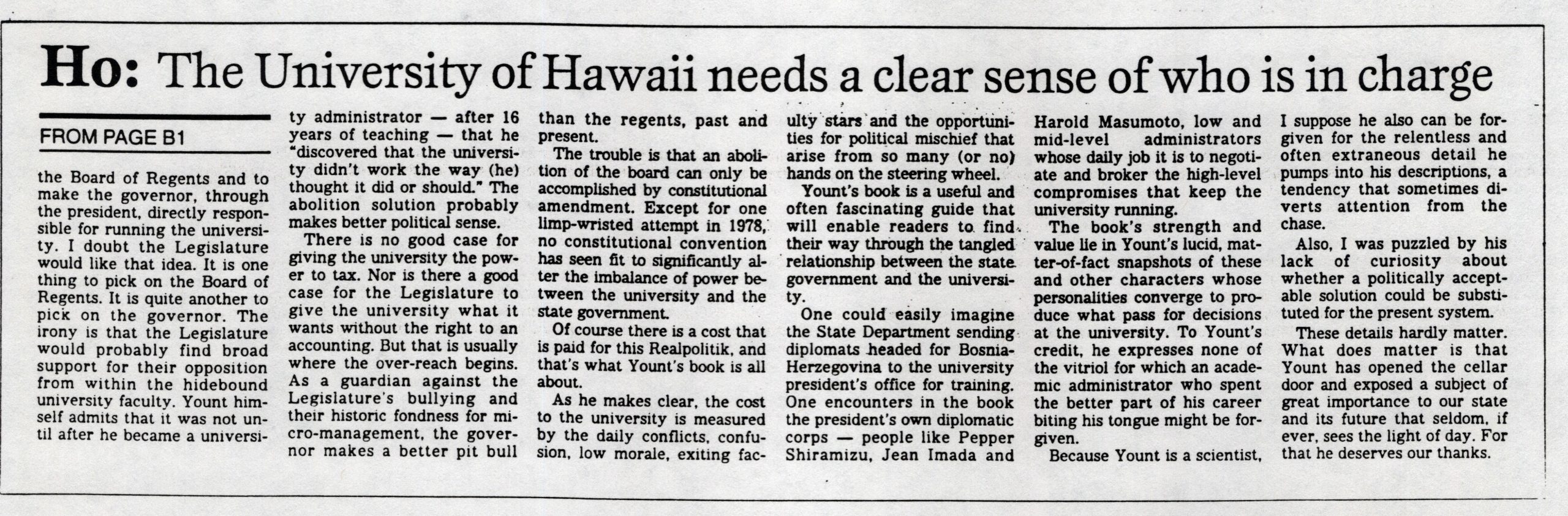
Companion commentary 3 of 3 — click to open full size Ethnic Humor
Topic: Society & CultureFrank DeLima, a comedian whose performances draw on Hawaii's many ethnic communities, and Corky Trinidad, a political cartoonist, discussed what distinguishes acceptable ethnic humor from humor that offends or demeans. The concrete question at issue is whether ethnic humor rooted in Hawaii's plantation-era multicultural experience can remain a unifying force as the state's population grows more diverse and less connected to that shared history. DeLima argued that ethnic humor in Hawaii developed as a form of mutual recognition among groups who lived and worked closely together, and that it functions to ease social tensions and welcome newcomers into the local community. He acknowledged, however, that the arrival of residents unfamiliar with that context complicates matters. Trinidad held that no subject is inherently off-limits for humor, with good taste serving as the only necessary restraint. Both guests discussed the difference between humor that laughs with a group and humor that mocks or denigrates it, and agreed that the ability to laugh at oneself is essential. Callers from the community raised specific cases, including the use of ethnic material in school performances.
Transcript
Read or download the full transcript (.txt). Speaker labels were assigned automatically and may contain errors.
Companion newspaper commentaries
Commentaries by the guests, published in The Honolulu Advertiser around the broadcast.
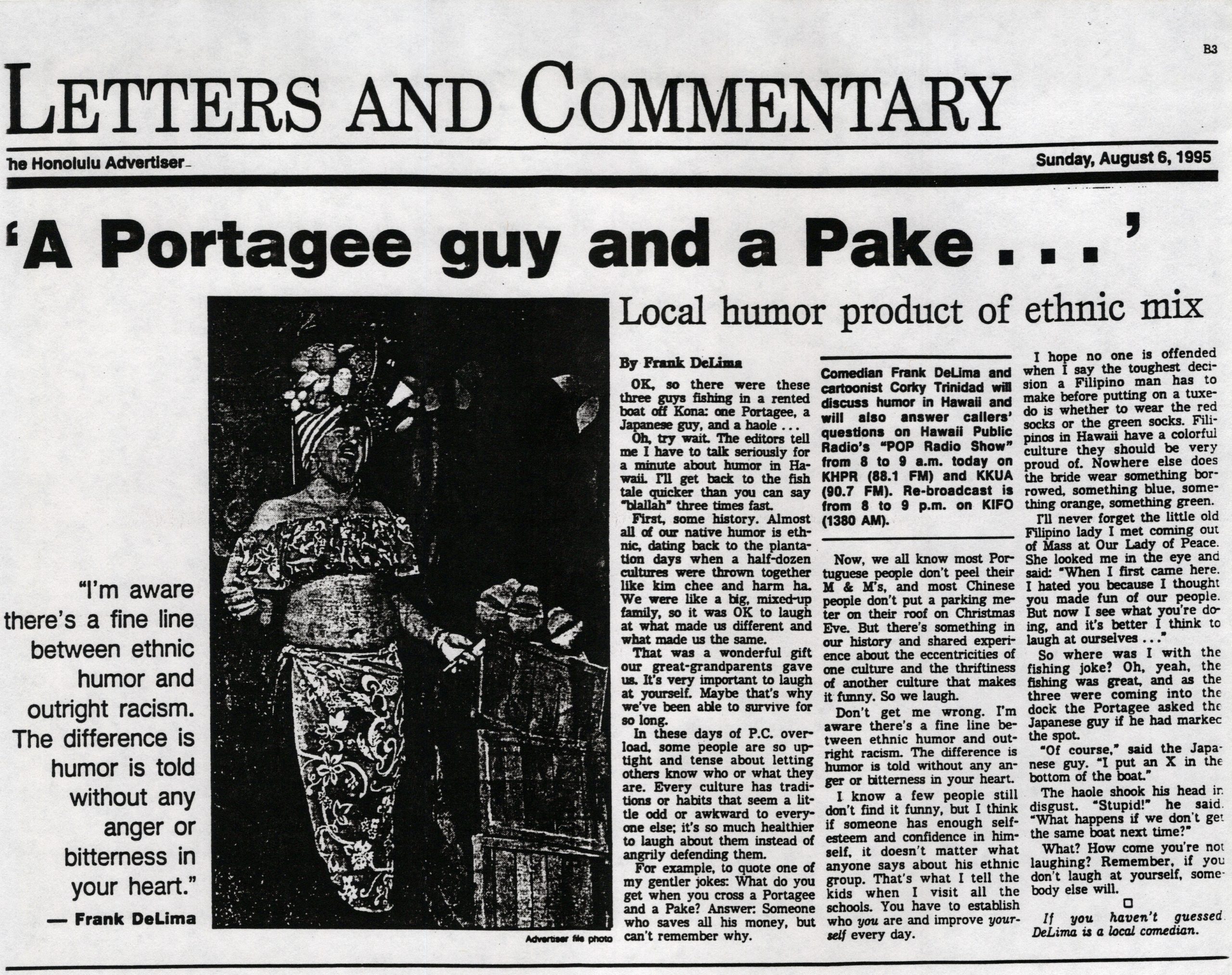
Companion commentary 1 of 1 — click to open full size Ethnic humor
Jonathan Okamura, a specialist with the University of Hawaii's Student Equity, Excellence and Diversity Program, and Patrick Downes, a songwriter who collaborated extensively with comedian Frank DeLima, examined the boundaries and social consequences of ethnic humor in Hawaii. The episode was prompted in part by public figures making comments that drew on ethnic stereotypes, and the central question is where the line falls between humor that builds community and material that reinforces discrimination. Downes described how his work with DeLima evolved from Hawaiian music into comedy, and argued that local humor in Hawaii is inseparable from ethnicity because of the islands' multicultural composition. He maintained that intent matters and that jokes become harmful only when they aim to belittle rather than to share recognition of common experience. Okamura took a more cautious position, arguing that comedy relying on demeaning stereotypes can cause real harm regardless of intent, particularly when directed at groups with less social and economic power. He noted that some groups in Hawaii are more vulnerable to these effects than others, and that the permissiveness around ethnic humor in the islands may bleed into more serious forms of public prejudice.
Transcript
Read or download the full transcript (.txt). Speaker labels were assigned automatically and may contain errors.
Companion newspaper commentaries
Commentaries by the guests, published in The Honolulu Advertiser around the broadcast.
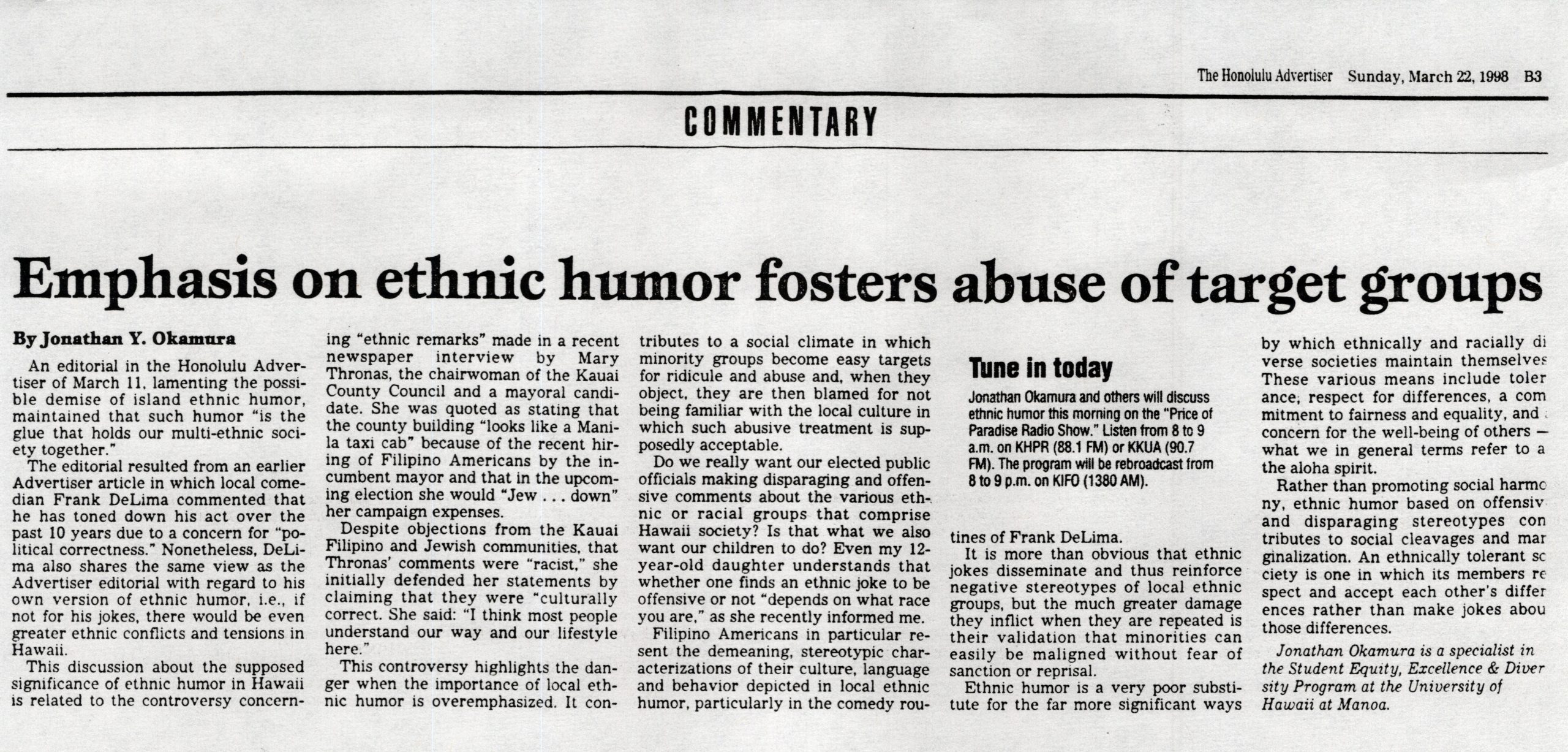
Companion commentary 1 of 1 — click to open full size Land Development vs
The question at the center of this June 1998 episode was whether Governor Cayetano should sign Senate Bill 2204, legislation that would require government agencies to automatically approve development permit applications if they failed to act within self-imposed deadlines. Dan Davidson, executive director of the Land Use Research Foundation, argued that Hawaii's permitting system was too slow, too costly, and economically damaging, and that SB 2204 would restore predictability by holding agencies accountable. Rick Egged, state director of planning, said the Cayetano administration had supported the bill as part of an economic revitalization package, believing automatic approval would change the culture of government inaction. Maile Bay, a land use consultant, countered that existing rules already required timely agency action and that automatic approval risked bypassing public participation; she cited a case in which a power-plant permit was approved by default despite a board vote against it. Bill Tam, an attorney specializing in natural resources law, agreed that the goal of streamlining was sound but argued that automatic approval was inherently dangerous, stripping decision-makers of any discretion once a deadline passed regardless of a project's merits.
Transcript
Read or download the full transcript (.txt). Speaker labels were assigned automatically and may contain errors.
Companion newspaper commentaries
Commentaries by the guests, published in The Honolulu Advertiser around the broadcast.
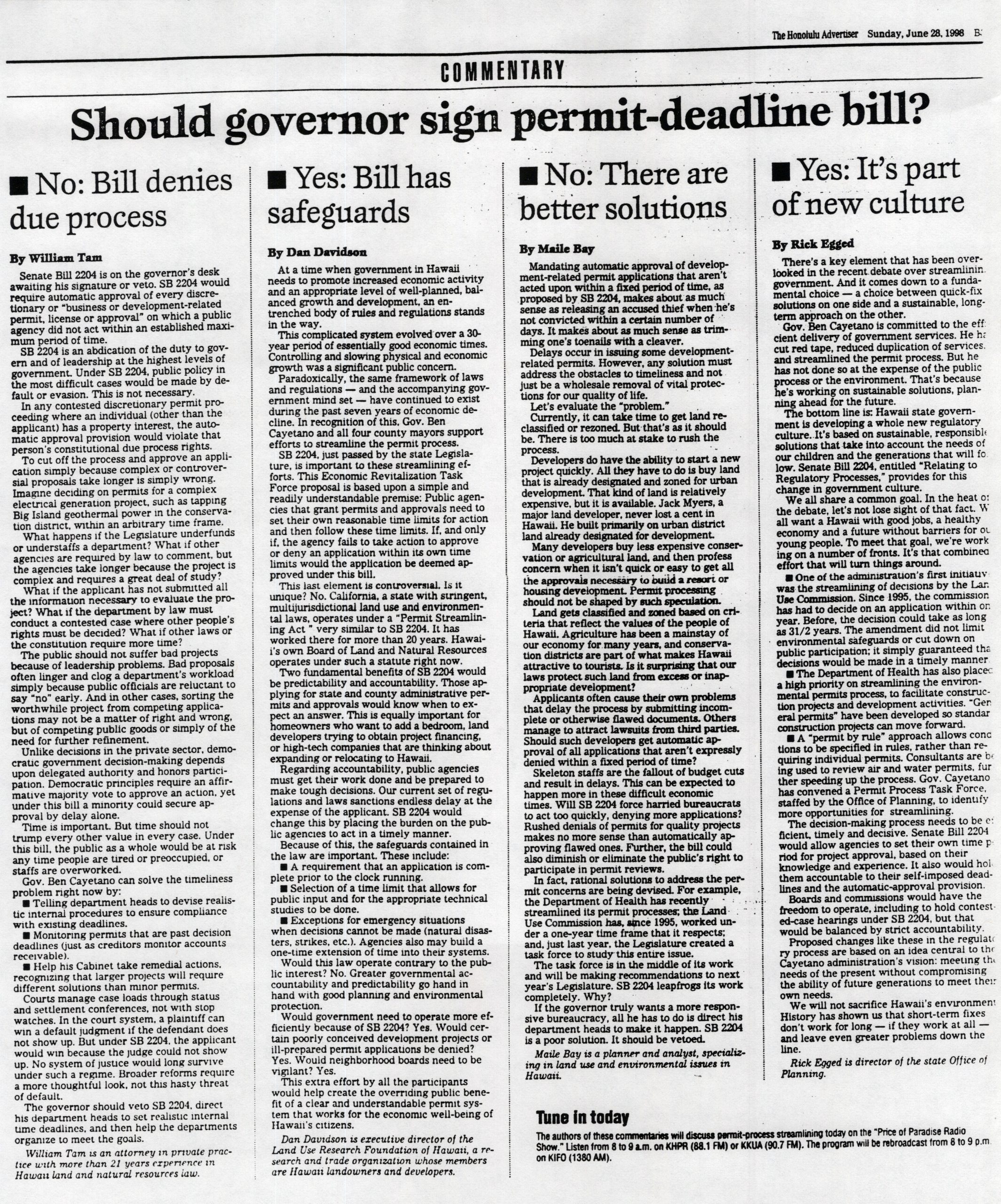
Companion commentary 1 of 1 — click to open full size Environmental Regulation
This March 1996 episode examined whether Hawaii's environmental regulations were appropriately protective or had become an unworkable burden. Lisa Munger, an environmental attorney who advises businesses on permit compliance, argued that regulations written in Washington for national application could not adequately account for local conditions and called for greater local discretion; she also expressed concern that highly technical rules placed smaller businesses at a competitive disadvantage. Paul Achitoff, a staff attorney with the Sierra Club Legal Defense Fund, took the opposing view, arguing that Hawaii's island environment — ecologically fragile, densely populated, and without an escape valve — required strong federal oversight precisely because local regulators were vulnerable to political pressure from developers and polluters. Cheryl Okuma-Sepe, director of wastewater for the City and County of Honolulu, offered a middle position: uniform national standards could be poorly suited to Hawaii's ocean-discharge environment, she said, citing expensive wastewater treatment requirements whose necessity she had successfully contested in federal court, but she did not oppose strong environmental goals. The standing question is whether an island state with unique ecological vulnerabilities should rely primarily on federal environmental standards or trust local authorities to set equivalent protections.
Transcript
Read or download the full transcript (.txt). Speaker labels were assigned automatically and may contain errors.
Companion newspaper commentaries
Commentaries by the guests, published in The Honolulu Advertiser around the broadcast.
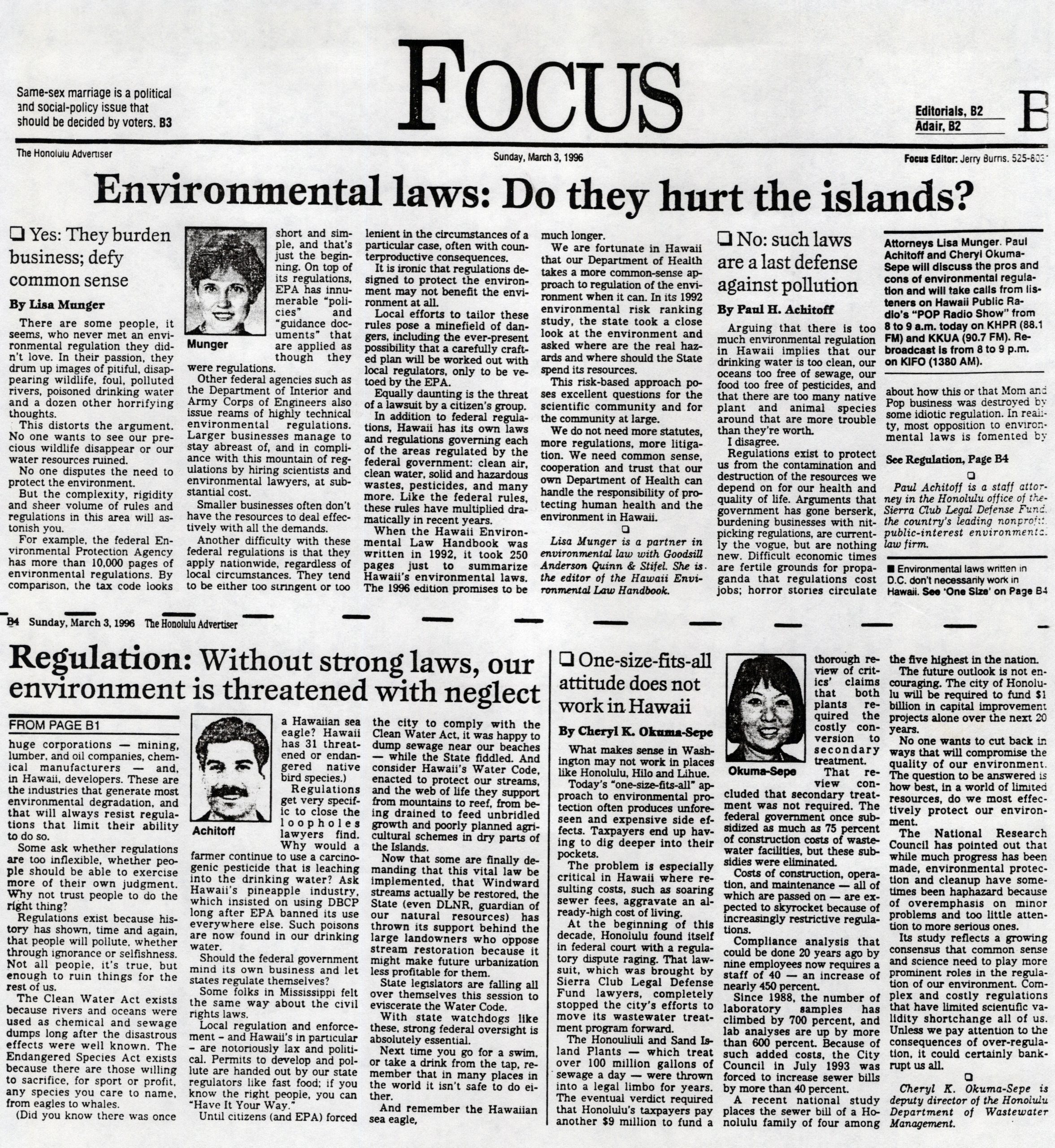
Companion commentary 1 of 1 — click to open full size Regulating Paradise
This spring 1994 episode centered on a book by David Callies, a professor of law at the University of Hawaii, titled Preserving Paradise: Why Regulation Won't Work. Callies argued that recent United States Supreme Court decisions on regulatory takings had made Hawaii's traditional approach to land-use control constitutionally precarious: the state could no longer restrict agricultural or conservation land without risking liability, and he urged a shift toward purchasing development rights rather than imposing regulatory prohibitions. Harold Masumoto, the state director of planning, disagreed that regulation was finished, arguing that courts would find sufficient remaining economic use — including grazing — in most restricted lands and that careful regulatory design could avoid successful legal challenges. Both guests agreed, however, that Hawaii's land-use system was overdue for structural reform. Masumoto had recently sponsored legislation to abolish the State Land Use Commission and transfer major planning decisions to the county level, a proposal Callies supported, though it did not advance in the legislature. The central question is how the state can preserve open space and manage vast tracts of land formerly used for plantation agriculture without incurring constitutional liability as economic conditions change and landowners grow more willing to sue.
Transcript
Read or download the full transcript (.txt). Speaker labels were assigned automatically and may contain errors.
Land Use Enforcement
This July 1994 episode examined the legal limits on government "exactions" — conditions imposed on development permits requiring developers to fund infrastructure such as roads, parks, and affordable housing. David Callies, a professor of law at the University of Hawaii and a recognized authority on land-use regulation, explained that a recent United States Supreme Court ruling had established a rough-proportionality test: government may exact only what bears a rational nexus to the specific impact a development causes. He argued that the City and County of Honolulu's practice of conditioning zoning approvals on affordable-housing contributions lacked any such nexus and would likely fail a legal challenge. Don Clegg, the city's director of land utilization, acknowledged that many exactions were legally dubious under the new standard but said the city would continue the practice until the courts ordered otherwise, given public demand and the absence of alternative funding. Both guests agreed the permitting process took far too long and that an excessive accumulation of laws was a significant cause. The episode also raised the question of whether bilateral development agreements would be more legally defensible than the city's current unilateral-agreement system, which both guests said they had long advocated for.
Transcript
Read or download the full transcript (.txt). Speaker labels were assigned automatically and may contain errors.
Should We Abolish the Land Use Commission?
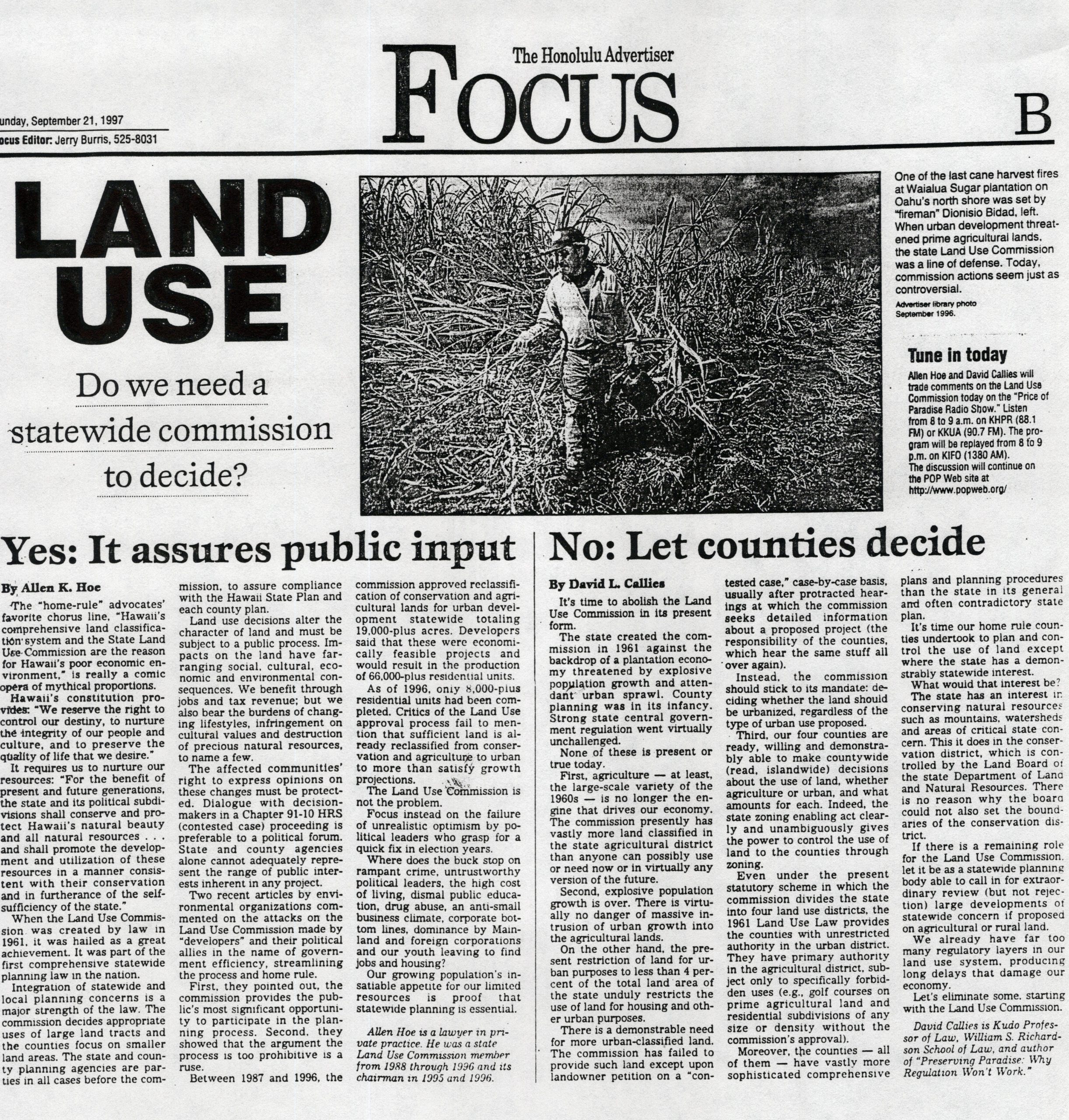
This September 1997 episode debated whether Hawaii should abolish its State Land Use Commission, the body that classifies all land as urban, agricultural, rural, or conservation. David Callies, Kudo Professor of Law at the University of Hawaii, argued the commission had outlived its original purpose and become a redundant, costly layer of bureaucracy; land classification decisions should be left to elected county governments, which maintain detailed development plans and are directly accountable to residents, rather than to an appointed quasi-judicial body that micromanages individual reclassification requests and adds years to the approval process. Allen K. Hoe, a lawyer and former chairman of the commission, countered that it serves an irreplaceable statewide function coordinating conservation, transportation, and cultural-resource interests that county governments address inconsistently, and that its quasi-judicial structure grants citizens stronger participatory rights than ordinary county hearings afford. Caller Astrid Monson, described by the host as an expert on land-use issues, challenged the premise that the commission caused high land prices, noting that thousands of already-approved but undeveloped lots suggested the obstacle lay with landowners and developers. The standing question is whether statewide oversight of land classification remains a necessary check or should be ceded to county governments.
Transcript
Read or download the full transcript (.txt). Speaker labels were assigned automatically and may contain errors.
Companion newspaper commentaries
Commentaries by the guests, published in The Honolulu Advertiser around the broadcast.
Companion commentary 1 of 1 — click to open full size