Hawaii Public Radio · 1993–1998
Price of Paradise Recordings and Commentaries
Hawaii Public Radio broadcast Price of Paradise from 1993 to 1998. Susie Roth produced and Randall Roth hosted almost all of the 220 broadcasts, bringing legislators, judges, scholars, executives and activists into the same hour to argue Hawaii’s hardest questions. Every broadcast below plays as a single complete recording, with a written summary and a full transcript. Episodes are being added as they are prepared.
Critics of the Hawaii Supreme Court
Topic: Law & the CourtsTwo senior members of the Hawaii bar, Daniel H. Case and Clinton R. Ashford, both former presidents of the Hawaii State Bar Association, argued that the Hawaii Supreme Court — particularly during the tenure of Chief Justice Richardson — had repeatedly crossed the line from interpreting law to making it. Both guests maintained that judicial activism, however popular, undermines the democratic process, erodes predictability in the law, and ultimately harms the public. Case pointed to insurance decisions in which the court, in his view, consistently strained to find coverage against insurers, imposing costs that ultimately fell on policyholders. Ashford drew on his personal experience in the Ashford case to argue that the court had shifted shoreline boundaries, effectively taking private property without compensation under the guise of public policy. Both guests raised concerns about the expansion of native Hawaiian gathering rights onto private and developed land, warning that such rulings threatened property owners' investment-backed expectations. The standing question is whether an activist court that enjoys popular support is nonetheless inflicting long-term legal and economic harm on Hawaii.
Transcript
Read or download the full transcript (.txt). Speaker labels were assigned automatically and may contain errors.
Companion newspaper commentaries
Commentaries by the guests, published in The Honolulu Advertiser around the broadcast.
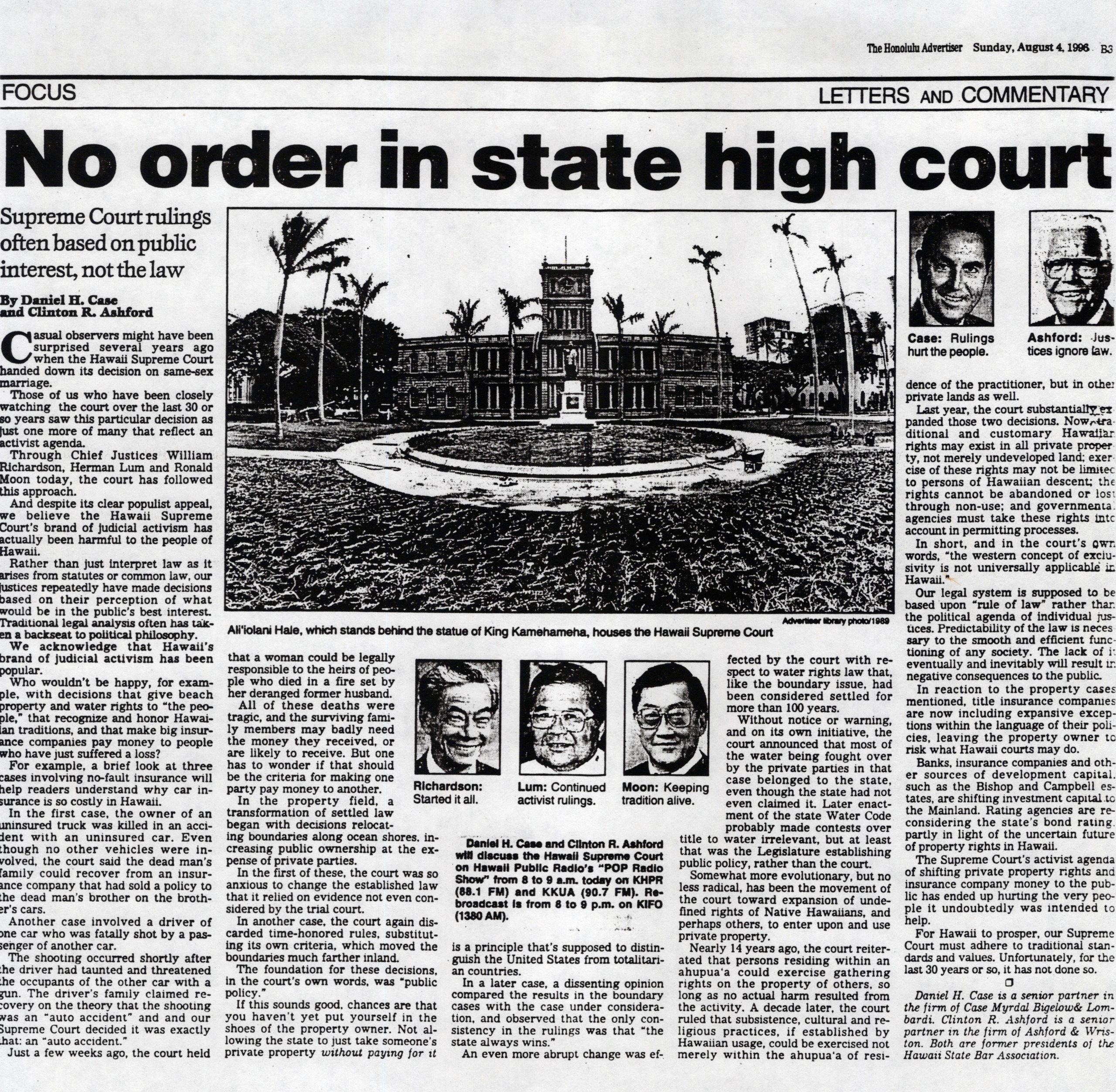
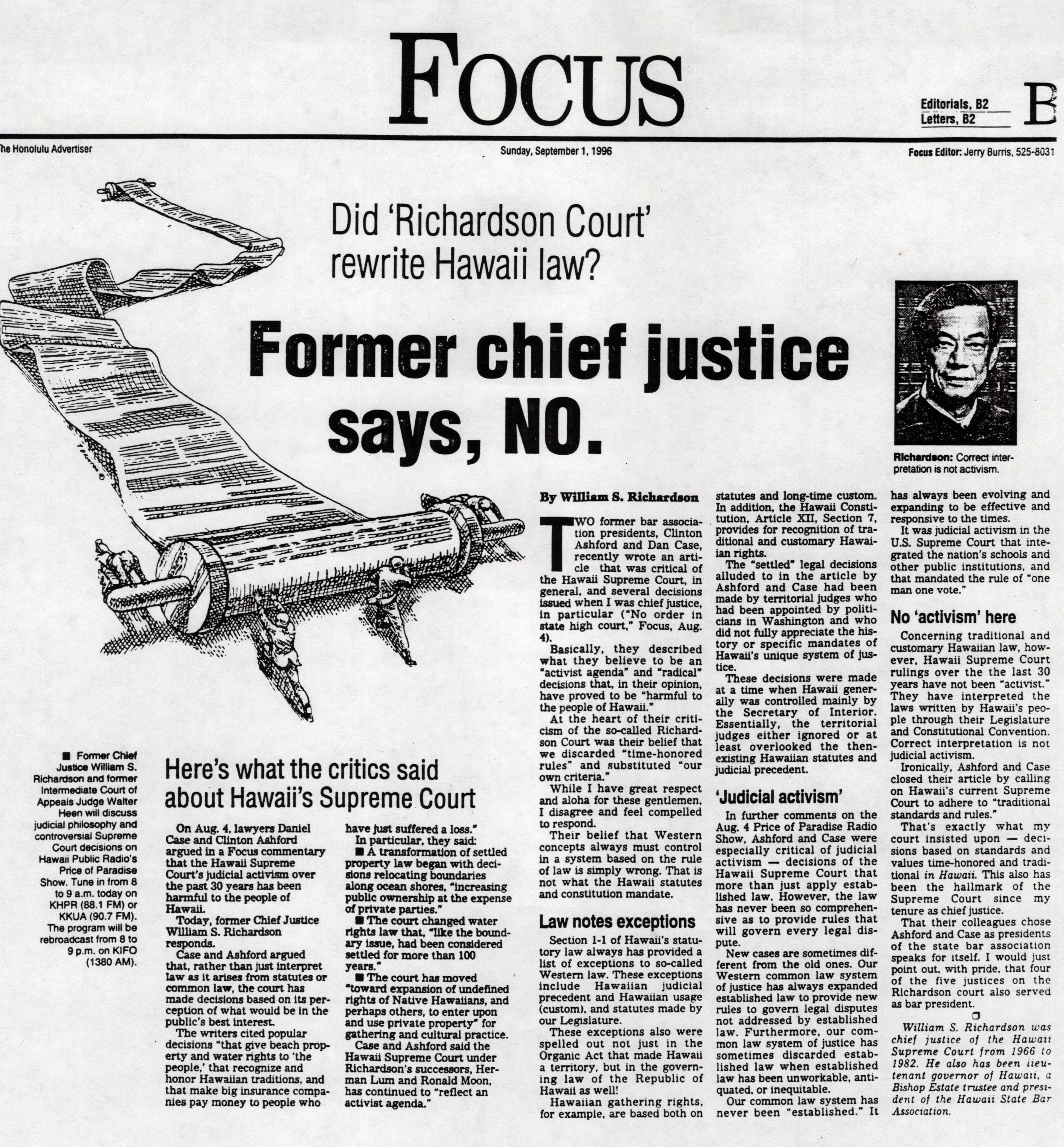
Companion commentary 1 of 1 — click to open full size A Response to Critics of the Hawaii Supreme Court
Topic: Law & the CourtsOne month after two attorneys publicly criticized the Hawaii Supreme Court for judicial overreach, the show heard from William S. Richardson, the Chief Justice most identified with the activist rulings, and Walter Heen, a former appellate judge. Richardson defended the shoreline boundary decisions of his court, arguing that Hawaiian tradition justified placing limits at the vegetation line rather than the historical surveyor's mark. Heen contended that the decisions criticized by Case and Ashford were products of a court appropriately responsive to real-world conditions, and that confusion surrounding native Hawaiian rights represented a natural stage in legal evolution rather than a defect. Both guests disputed the investment-backed expectations argument advanced by their critics, with Heen suggesting that non-native property owners complaining of sudden rule changes were experiencing something of what Hawaiians themselves had suffered since the 1848 imposition of fee-simple land title. Richardson acknowledged that personal values inevitably inform judicial reasoning but maintained that this does not make outcomes illegitimate. The standing question is whether judicial decisions shaped by a social equity agenda constitute illegitimate lawmaking or a proper exercise of judicial discretion.
Transcript
Read or download the full transcript (.txt). Speaker labels were assigned automatically and may contain errors.
Companion newspaper commentaries
Commentaries by the guests, published in The Honolulu Advertiser around the broadcast.
Companion commentary 1 of 1 — click to open full size Bishop Estate 1997 Master’s Report
Carroll Taylor, a Honolulu trust lawyer with no financial interest in the Bishop Estate, discussed a court-appointed master's report released on November 17, 1997, covering the estate's fiscal year 1994. Taylor explained that under the terms of Princess Bernice Pauahi Bishop's will, trustees are required to seek periodic court approval of their accounts, and that the master — an attorney acting as a deputy to the probate judge — investigates those accounts and reports back. The 1997 report documented several instances of non-compliance with prior court orders: trustees had failed to disclose the fair market value of estate assets, to publish annual schedules of gains and losses, and to produce a long-required strategic plan. Taylor noted that past accounting approvals might not shield trustees from liability if material information — including details of co-investment by individual trustees in estate holdings — had never been disclosed. He concluded that the report was necessarily incomplete because adequate information had still not been supplied. The central question is whether the probate court will impose meaningful consequences for non-compliance, up to and including the removal of trustees.
Transcript
Read or download the full transcript (.txt). Speaker labels were assigned automatically and may contain errors.
Companion newspaper commentaries
Commentaries by the guests, published in The Honolulu Advertiser around the broadcast.
Companion commentary 1 of 1 — click to open full size Bishop Estate Controversy and Trustee Selection
Gladys Brandt, former principal of Kamehameha Schools, Walter Heen, a retired judge of the Hawaii Intermediate Court of Appeals, and Samuel P. King, a Senior U.S. District Court Judge, discussed how Bishop Estate trustees should be selected following the Hawaii Supreme Court's decision to withdraw from that role. All three agreed that four of the five justices had acted correctly, with King stressing the ethical contradiction of justices appointing trustees when the same court must later rule on cases involving the estate. The guests, who had co-authored a newspaper article on the subject, recommended that the probate court assume responsibility for future selections, conducting the process openly and drawing on input from native Hawaiian organizations. Brandt argued that candidates should adhere to the Protestant religion as specified in the Princess's will, a criterion past justices had declined to apply. King explained the legal distinction between that criterion for trustees and the federal prohibition on religious discrimination in employment, noting that no court had ruled the Protestant requirement for trustees unconstitutional. The governing question is what criteria and process should determine trustee selection now that the Supreme Court has stepped aside.
Transcript
Read or download the full transcript (.txt). Speaker labels were assigned automatically and may contain errors.
Companion newspaper commentaries
Commentaries by the guests, published in The Honolulu Advertiser around the broadcast.
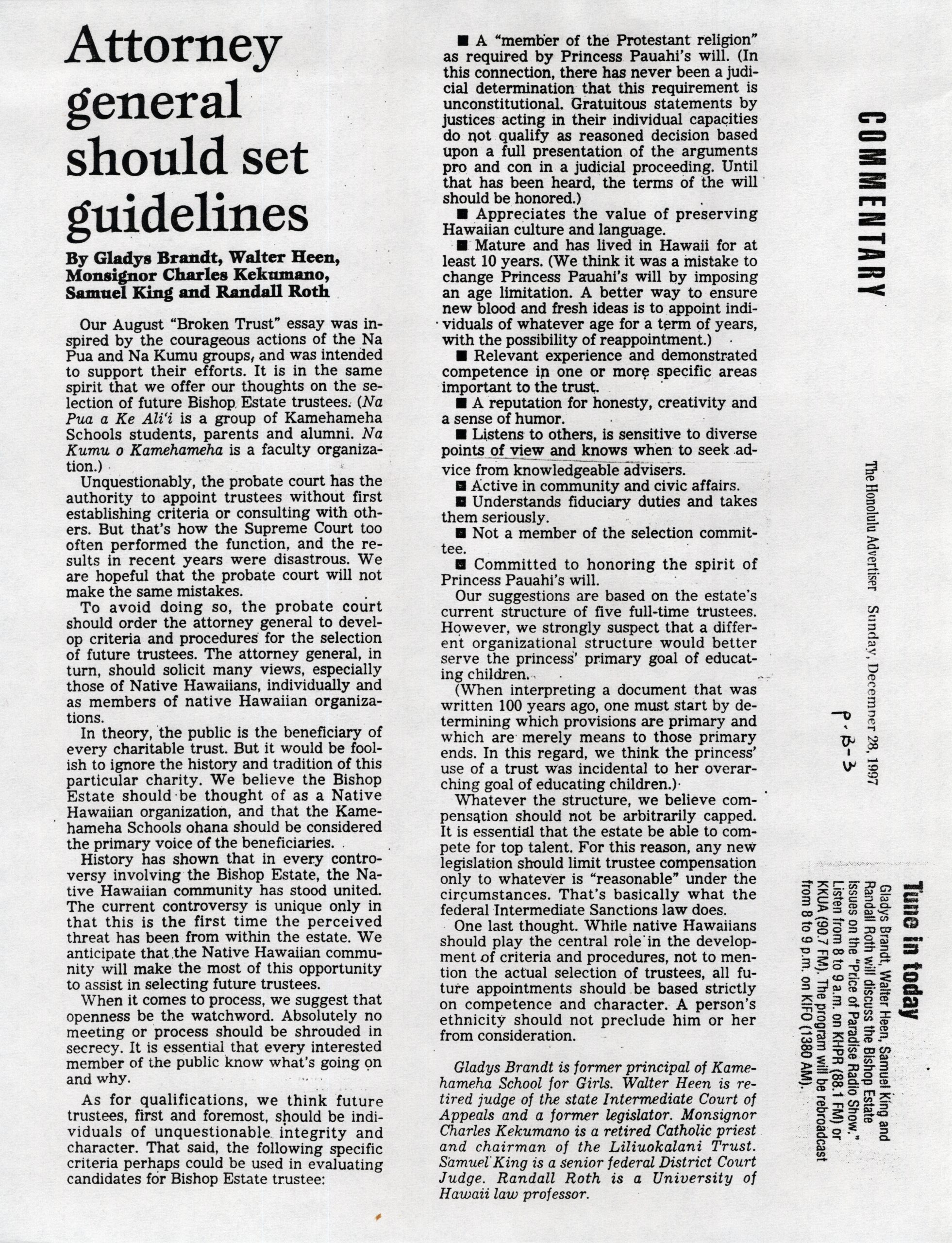
Companion commentary 1 of 2 — click to open full size 
Companion commentary 2 of 2 — click to open full size Talking Story with Two Bishop Estate Trustees
Two of the Bishop Estate's five trustees, Richard "Dickie" Wong, a former president of the State Senate, and Gerry Jervis, a lawyer and real estate developer, appeared together to describe the estate's current direction and respond to public criticism. Both trustees outlined plans to expand Kamehameha Schools from roughly 560 students to 1,800 through four new campuses on Oahu, Maui, and the Big Island, and described an investment strategy shifting beyond traditional land holdings toward a diversified portfolio with mainland and international positions. Both defended trustee compensation — running to six or seven figures annually, calculated as a commission on performance — against listener questions about whether such amounts should instead be directed to Hawaiian children's education. On the McKenzie methane co-investment controversy, then in litigation, both maintained the investment had been proper and that an independent legal opinion had cleared the conflict-of-interest question; they acknowledged the board had nonetheless adopted a policy barring future co-investment by trustees and employees. The standing question is whether the estate's business practices and compensation structure are consistent with its obligations as a charitable trust.
Transcript
Read or download the full transcript (.txt). Speaker labels were assigned automatically and may contain errors.
Companion newspaper commentaries
Commentaries by the guests, published in The Honolulu Advertiser around the broadcast.
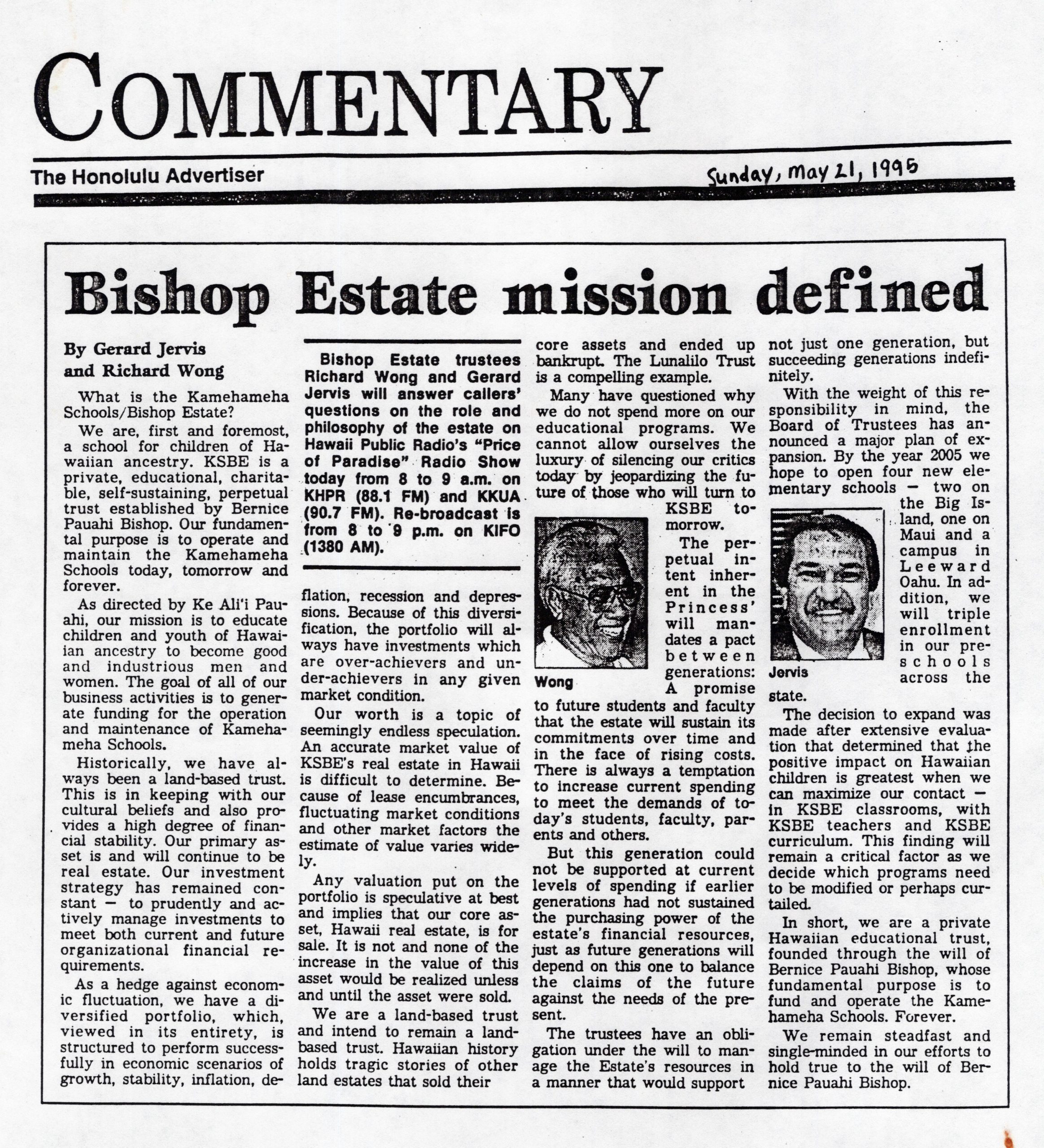
Companion commentary 1 of 2 — click to open full size Companion commentary 2 of 2 — click to open full size Kamehameha Schools “Lead” Trustee for Education
Lokelani Lindsey, one of five Kamehameha Schools Bishop Estate trustees, spent an hour answering listener questions about the estate's recent changes in educational strategy. The standing question is how a self-sustaining charitable trust — one that must generate its own income from investments — should allocate resources among the estimated 40,000 Hawaiian children who will never attend a Kamehameha campus. Lindsey defended the decision to eliminate several community outreach programs, arguing that full-time preschool instruction had proved more effective at preventing educational risk than remedial programs introduced after children had already fallen behind. She explained the restoration of merit-based admissions for grades K-12, while preschool enrollment remained on a lottery, and described the new Neighbor Island schools — initially serving grades K-3 on Maui and the Big Island — as a way to keep younger children near their families. Callers raised trustee compensation, which Lindsey described as a statutory two-percent commission on estate earnings; the estate's management of former Hamakua Sugar land; and allegations of micromanagement in curriculum and communications decisions, a charge she partially acknowledged while defending the policy rationale.
Transcript
Read or download the full transcript (.txt). Speaker labels were assigned automatically and may contain errors.
Companion newspaper commentaries
Commentaries by the guests, published in The Honolulu Advertiser around the broadcast.
Companion commentary 1 of 2 — click to open full size 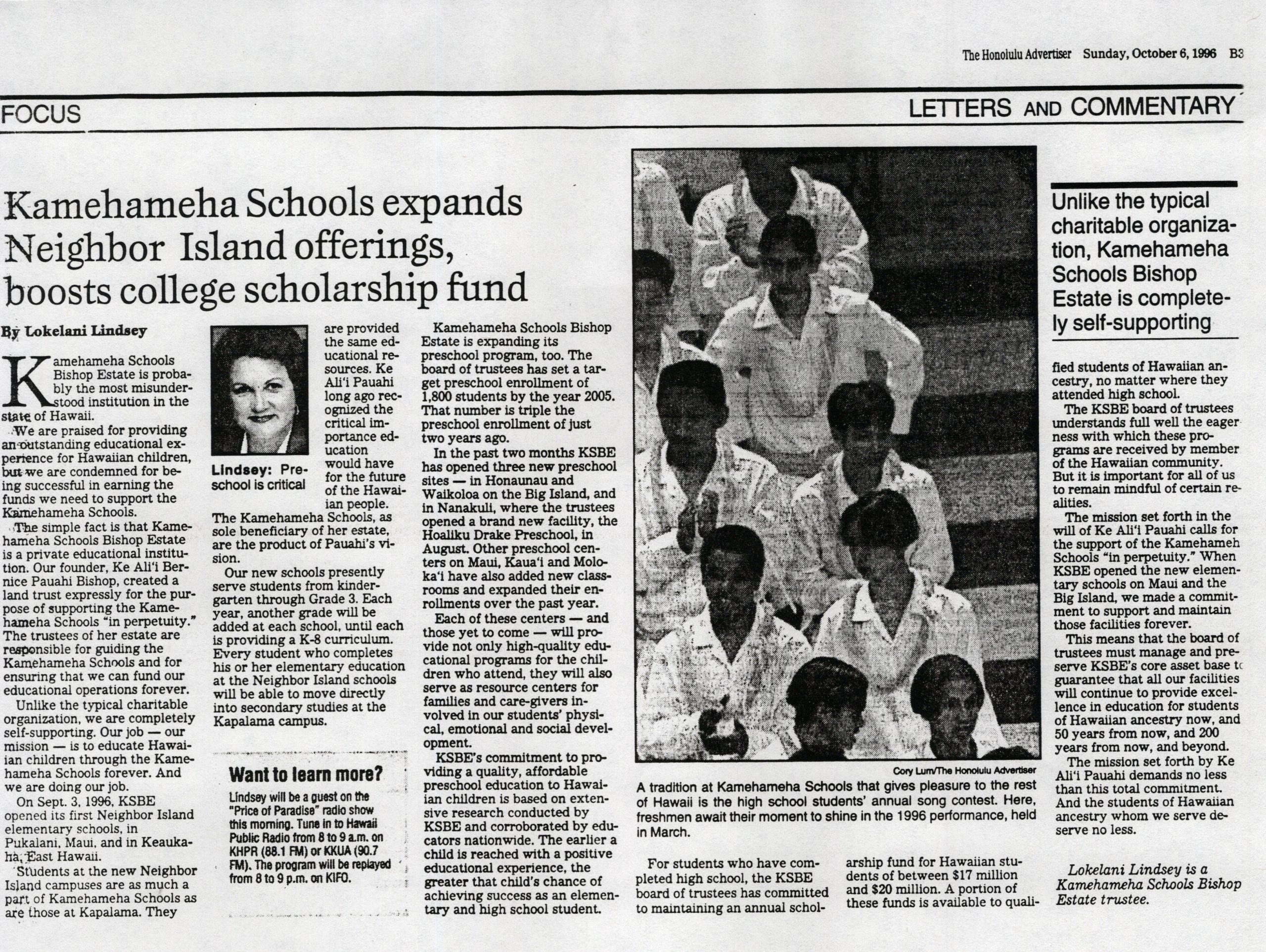
Companion commentary 2 of 2 — click to open full size Bishop Estate Debate
Bishop Estate Trustee Oz Stender and Desmond Byrne, executive director of Common Cause Hawaii, examined whether Hawaii's largest private charitable trust was governing itself with appropriate transparency and fulfilling its educational mission. Byrne contended that the practice of having Hawaii Supreme Court justices select trustees in an unofficial capacity created conflicts of interest with no precedent elsewhere in the country, violating multiple canons of judicial ethics. Stender maintained the arrangement was required by the will of founder Bernice Pauahi Bishop and that openly disclosed conflicts were manageable. On the estate's educational record, both agreed that more needed to be done for Hawaiian children, though Stender cautioned against expanding programs so rapidly as to strain the endowment. Byrne called for the estate's strategic plan to be made public, arguing that an institution controlling a significant share of Hawaii's land and serving thousands of students could not operate without greater accountability. The episode also addressed a Honolulu ordinance requiring leasehold condominium conversion, which Stender opposed as an unconstitutional government transfer of private property. Stender outlined a long-range vision of a globally managed institution capable of serving Hawaiian children well into the twenty-first century.
Transcript
Read or download the full transcript (.txt). Speaker labels were assigned automatically and may contain errors.
Companion newspaper commentaries
Commentaries by the guests, published in The Honolulu Advertiser around the broadcast.
Companion commentary 1 of 1 — click to open full size Climate Change and its Impact
Three University of Hawaii professors examined what global warming might mean for the Hawaiian Islands. The central question is whether the documented rise in global temperatures — roughly one to two degrees Fahrenheit over the past century — will produce significant consequences for Hawaii's coastlines, water supply, ecosystems, and severe weather. Fred Mackenzie, a professor of oceanography, confirmed that temperatures are rising at a rate somewhat faster than natural variability would suggest and noted evidence of ozone depletion above Hawaii, including unusually low ozone levels recorded in the winter of 1994. Tom Giambelluca, a climatologist, described sea level rise as a concern for the coming century, with estimates ranging from less than four inches to several feet, driven principally by the thermal expansion of ocean water rather than ice-cap melting. Tom Schroeder, a meteorologist, cautioned against assuming that warmer ocean temperatures would simply produce more or stronger hurricanes, explaining that cyclone formation requires six concurrent factors and that climate models had produced inconclusive results on this point. All three agreed that warming is occurring; the debate centred on the degree of scientific uncertainty surrounding its local effects on precipitation, biodiversity, and extreme weather events.
Transcript
Read or download the full transcript (.txt). Speaker labels were assigned automatically and may contain errors.
Companion newspaper commentaries
Commentaries by the guests, published in The Honolulu Advertiser around the broadcast.
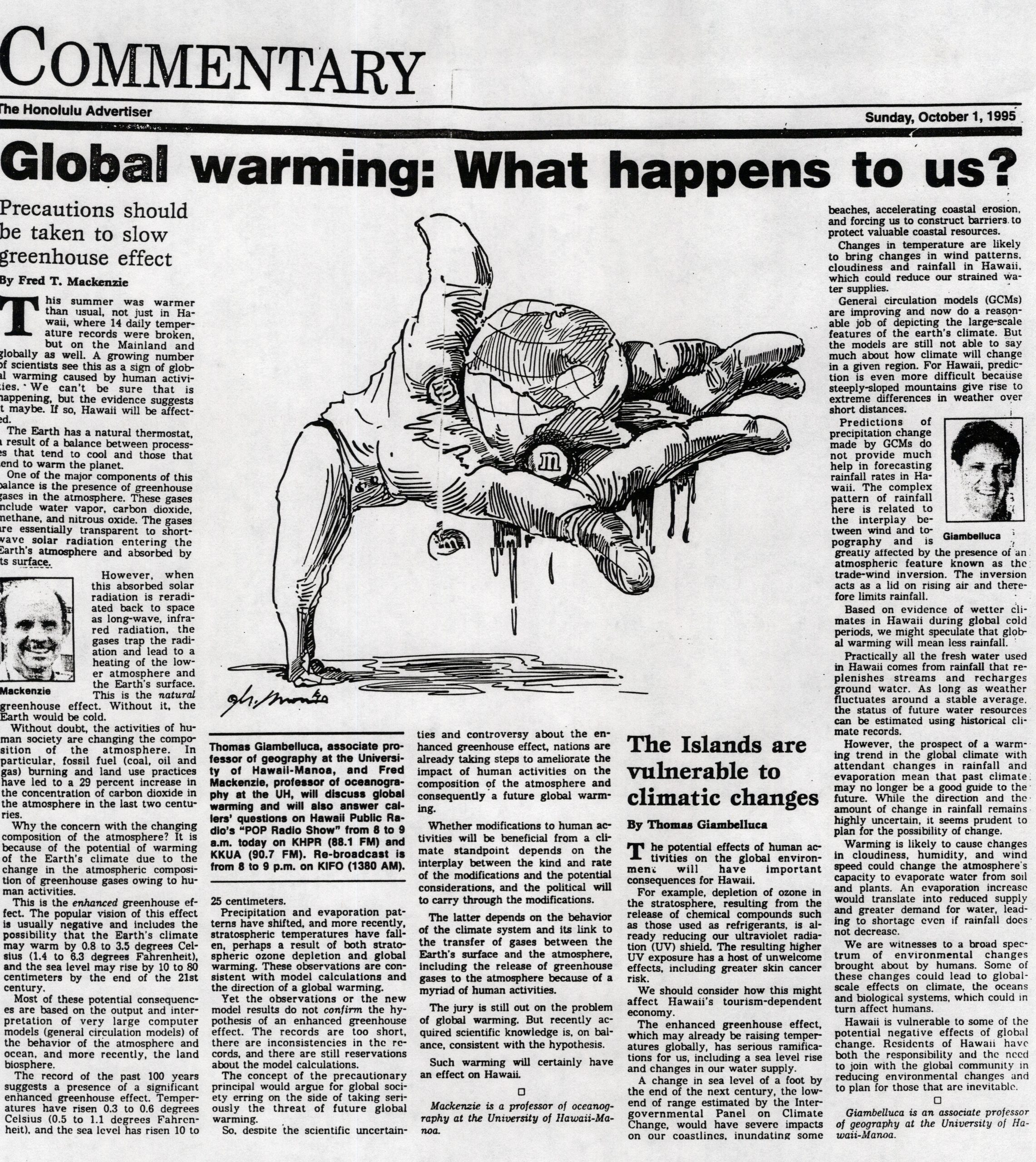
Companion commentary 1 of 1 — click to open full size Traffic Congestion
The central question is whether Oahu's worsening traffic congestion can be meaningfully reduced, and if so, by what means. Gordon Lum, executive director of the Oahu Metropolitan Planning Organization, described a multiprong regional plan that included approximately $5.5 billion in highway improvements, more than $11 billion in transit investment, and lower-cost measures such as parking management, high-occupancy vehicle lanes, and ridesharing. He acknowledged that projected population growth of 22 percent by 2020 would outpace any short-range gains, and that limited road space and funding made large-scale expansion difficult. Lou Rose, a professor of economics at the University of Hawaii, argued that the most effective remedy was congestion pricing — variable charges applied only during peak periods — giving drivers a direct financial incentive to shift travel times or modes. Lum noted that political leaders had resisted pricing, partly because in Honolulu, lower-income commuters typically live farther from the urban core and would bear a disproportionate burden. Rose countered that an income tax credit could address that inequity. Hugh Ono, chief of the highway division of the State Department of Transportation, called in near the end of the programme to discuss parallel congestion problems developing on the Neighbor Islands.
Transcript
Read or download the full transcript (.txt). Speaker labels were assigned automatically and may contain errors.
Companion newspaper commentaries
Commentaries by the guests, published in The Honolulu Advertiser around the broadcast.
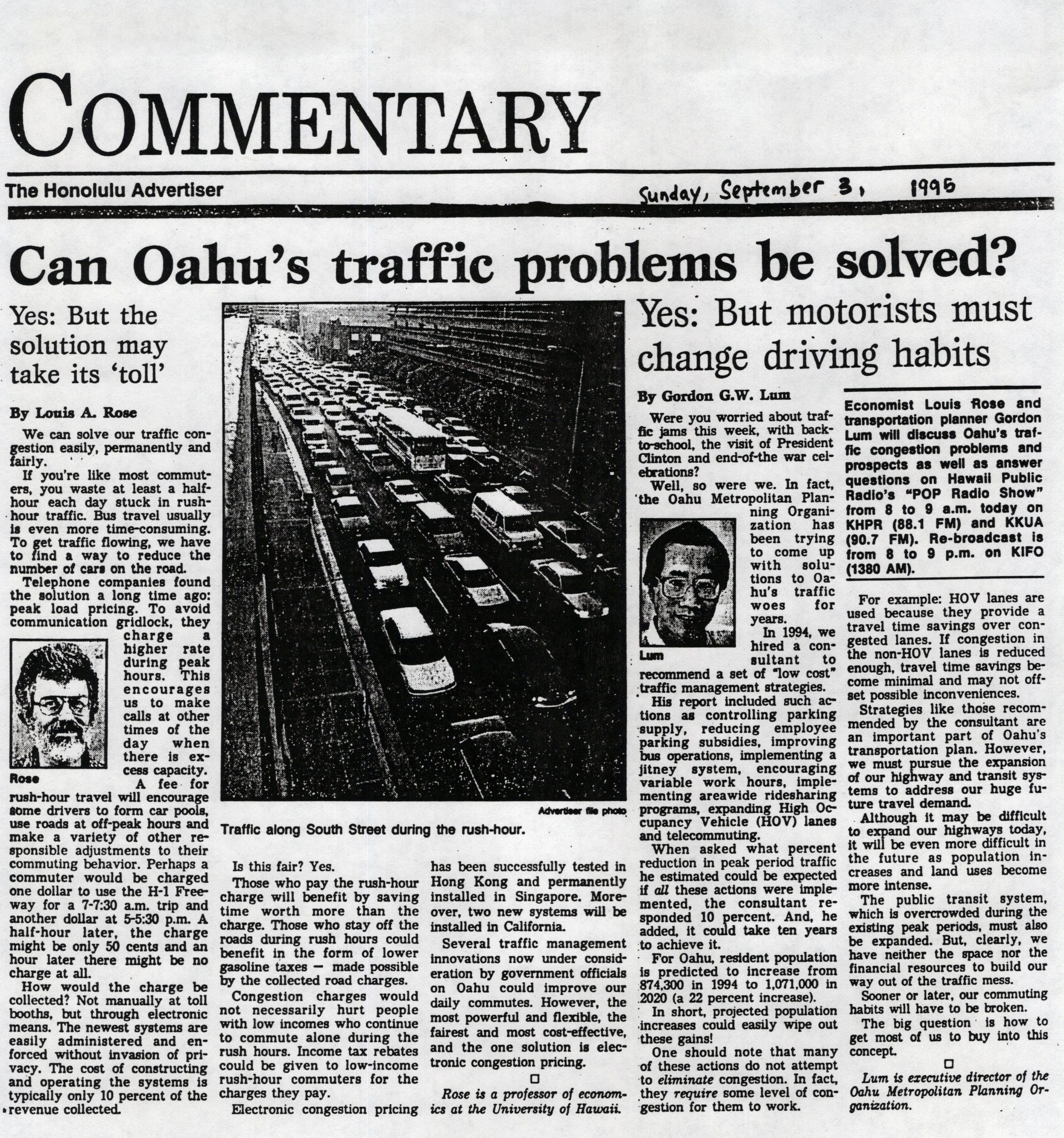
Companion commentary 1 of 1 — click to open full size Legalized Gambling
The question before six panelists is whether Hawaii should legalize gambling, a debate given urgency by the state's budget difficulties. Linda Lingle, Mayor of Maui, argued that legalization would redistribute rather than generate new revenue, harm small businesses, and impose social costs that had not been adequately studied. U.S. Attorney Steve Alm contended that legalization would increase crime, including organized criminal activity and offenses by pathological gamblers unable to cover their debts. David Carey, president of Outrigger Enterprises, took a more open position, suggesting that a modest, Monte Carlo-style amenity could help Hawaii remain competitive with tourism destinations that had already introduced gaming. Joseph Toy, a hospitality consultant, reported that a survey of roughly 550 Hawaii adults found 42 percent in favor of legalized gaming. Bill Eadington, director of the Institute for the Study of Gambling and Commercial Gaming at the University of Nevada, argued that the economics of legal gambling tend to be positive while social harms are real but hard to measure, and he challenged the accuracy of crime statistics cited by opponents. Joe Souki, Speaker of the Hawaii House of Representatives, said the legislature intended to study the full impact on quality of life before taking action.
Transcript
Read or download the full transcript (.txt). Speaker labels were assigned automatically and may contain errors.
Companion newspaper commentaries
Commentaries by the guests, published in The Honolulu Advertiser around the broadcast.

Companion commentary 1 of 1 — click to open full size

