Hawaii Public Radio · 1993–1998
Price of Paradise Recordings and Commentaries
Hawaii Public Radio broadcast Price of Paradise from 1993 to 1998. Susie Roth produced and Randall Roth hosted almost all of the 220 broadcasts, bringing legislators, judges, scholars, executives and activists into the same hour to argue Hawaii’s hardest questions. Every broadcast below plays as a single complete recording, with a written summary and a full transcript. Episodes are being added as they are prepared.
Dueling Historians: Debating the Overthrow I
Topic: Sovereignty & the OverthrowThurston Twigg-Smith, a descendant of Lorrin A. Thurston and former owner of The Honolulu Advertiser, and Davianna Pōmaikaʻi McGregor, professor of ethnic studies at the University of Hawaii, disagreed sharply over whether the 1893 overthrow of the Hawaiian monarchy was a revolution or an illegal invasion. McGregor argued that the matter had been settled by the federal Apology Law of 1993 (Public Law 103-150), which she helped draft and which she said formally acknowledged United States responsibility for the overthrow; she called for repatriation of crown and government lands to native Hawaiians as the next step toward reconciliation. Twigg-Smith countered that the law's preamble clauses carried no binding legal force and that the overthrow should be understood as a justified response to a monarchy that had grown unstable and was losing the confidence of its own supporters. He also denied that the events of 1893 or subsequent annexation had victimised Hawaiians. Both guests took listener telephone calls during the programme's second half.
Transcript
Read or download the full transcript (.txt). Speaker labels were assigned automatically and may contain errors.
Companion newspaper commentaries
Commentaries by the guests, published in The Honolulu Advertiser around the broadcast.
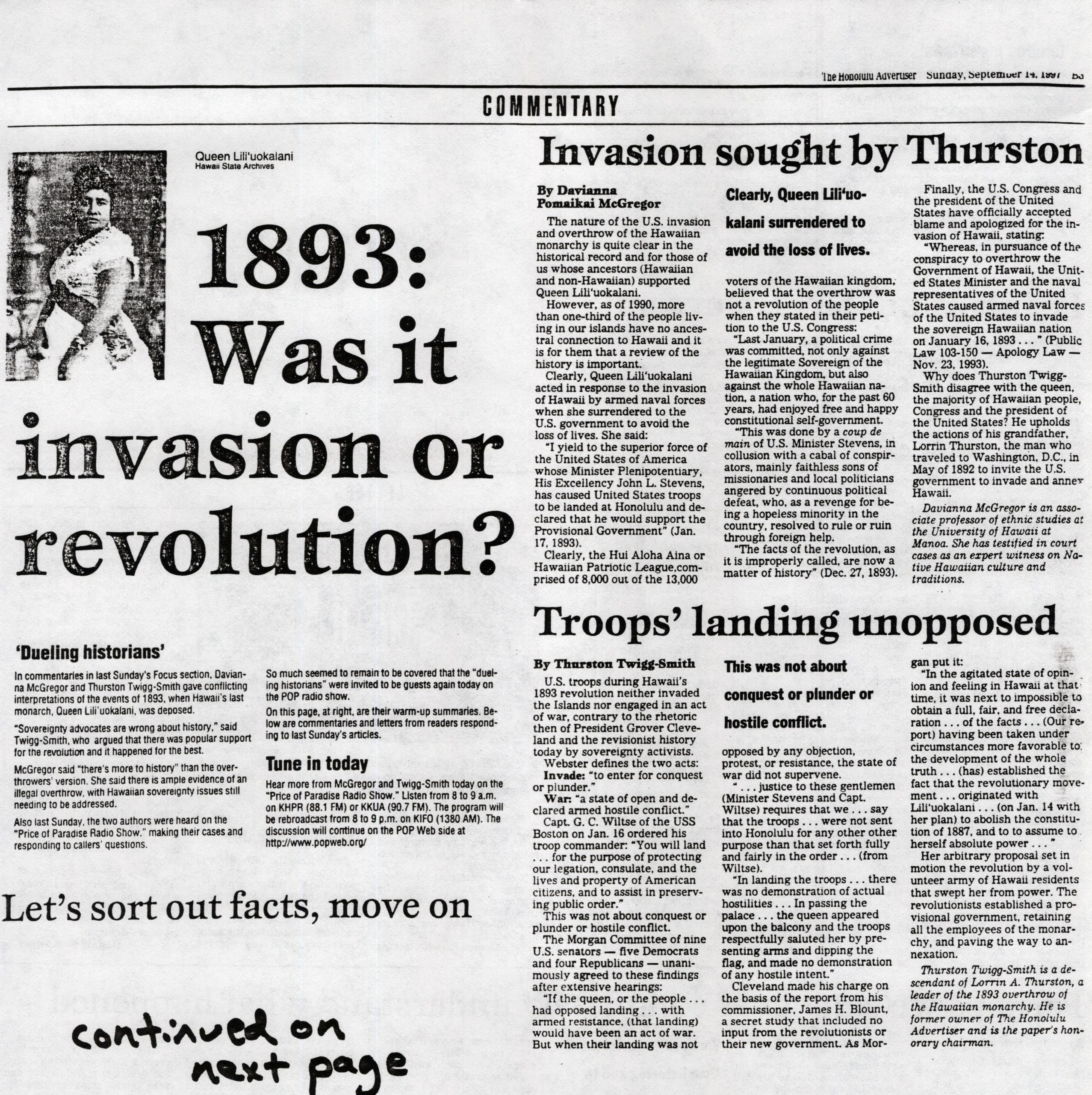
Companion commentary 1 of 3 — click to open full size 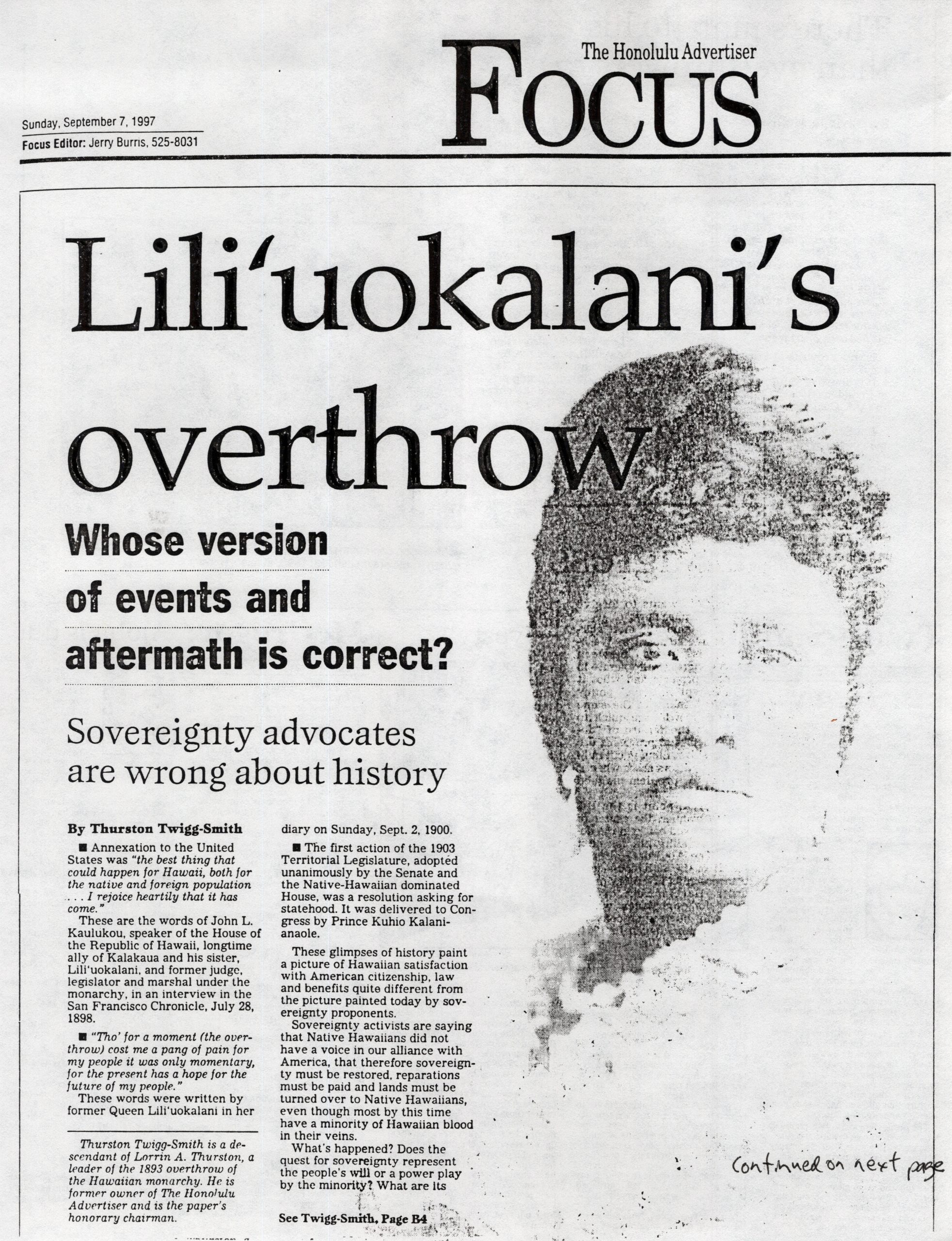
Companion commentary 2 of 3 — click to open full size 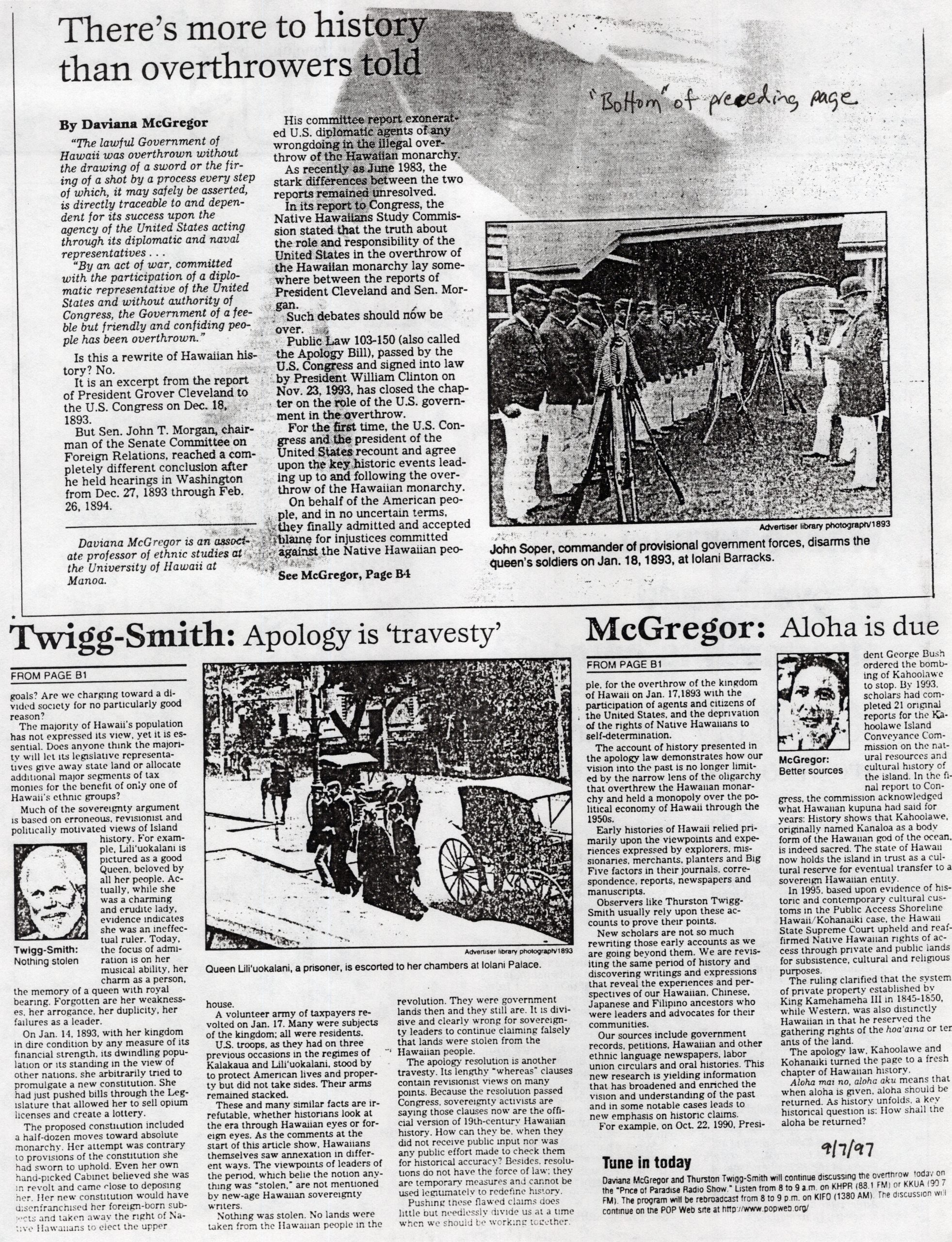
Companion commentary 3 of 3 — click to open full size Dueling Historians: Debating the Overthrow II
Topic: Sovereignty & the OverthrowThe second of two consecutive broadcasts on the 1893 overthrow of the Hawaiian monarchy brought Thurston Twigg-Smith and Davianna Pōmaikaʻi McGregor back to reassess the previous week's central dispute: was the overthrow a revolution or an invasion? The programme opened with each guest making the strongest possible case for the other's position, an exercise that revealed substantive arguments on both sides, before the principals resumed their own lines. McGregor maintained that Queen Liliuokalani was an effective and beloved leader who chose not to resist the landing of American troops in order to spare Hawaiian lives, and that the absence of armed opposition could not be read as popular consent to the removal of the monarchy. Twigg-Smith contended that the Queen had alienated even her own supporters when she attempted to proclaim a new constitution, and he disputed the legal significance of the congressional Apology Resolution's factual recitals. Listener callers pressed both guests on the relationship between the historical events and contemporary sovereignty claims.
Transcript
Read or download the full transcript (.txt). Speaker labels were assigned automatically and may contain errors.
Companion newspaper commentaries
Commentaries by the guests, published in The Honolulu Advertiser around the broadcast.
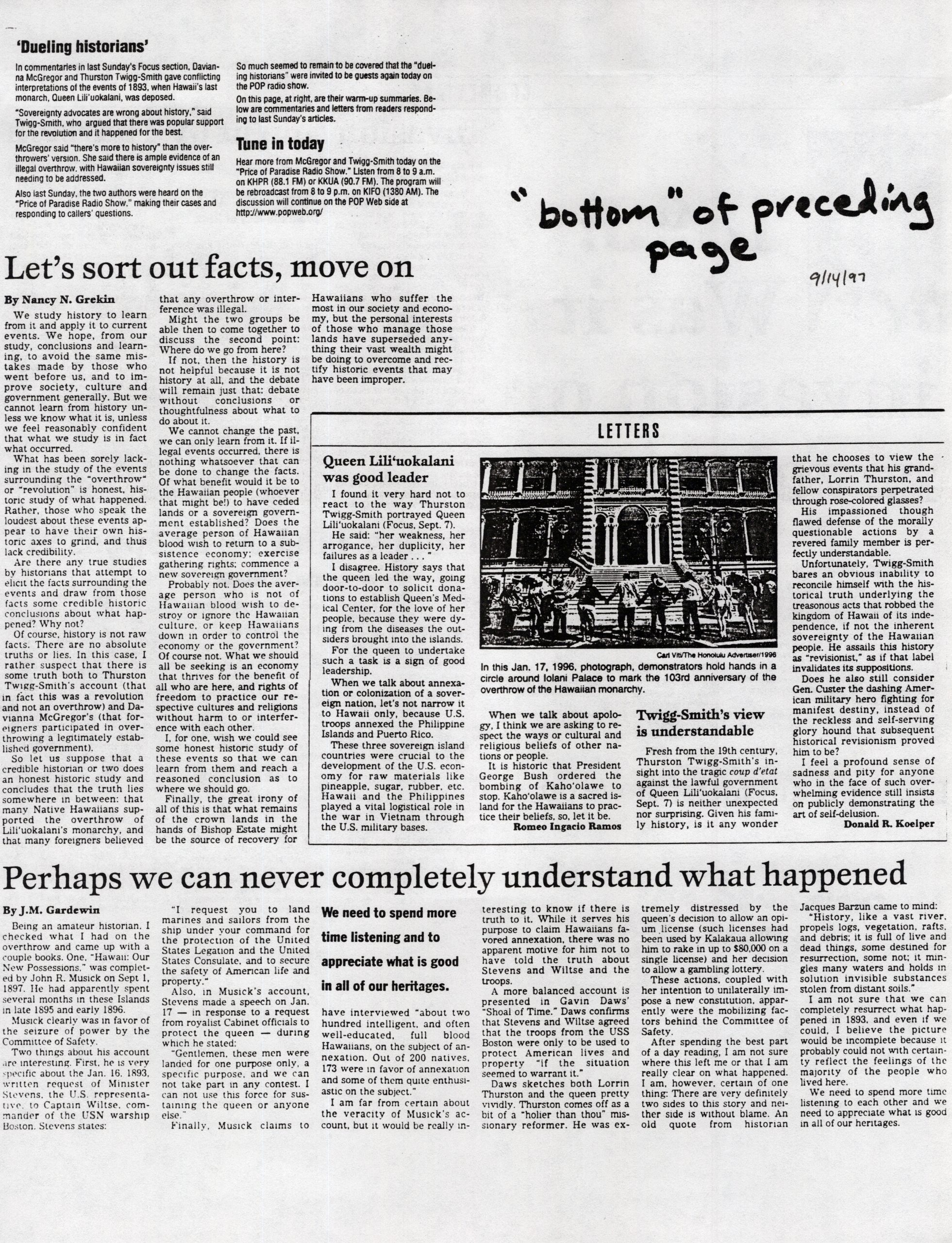
Companion commentary 1 of 1 — click to open full size Discussion of Thurston Twigg-Smith’s Book about the Overthrow
Thurston Twigg-Smith joined three critics in a live discussion of his recently published book, "Hawaiian Sovereignty: Do the Facts Matter?" The author summarised its main claims: that the sovereignty movement rests on historical revisionism, that land was never stolen from native Hawaiians, that Queen Liliuokalani's own actions contributed to the overthrow, and that the movement was building expectations it could not deliver, with a risk of social unrest. Mahealani Kamauʻu, executive director of the Native Hawaiian Legal Corporation, called the book hostile and factually wrong, and rejected its suggestion that sovereignty advocates were inclined toward violence. Jon Van Dyke, a law professor at the University of Hawaii, disputed Twigg-Smith's assertion that the 1993 Apology Resolution lacks the force of law. Walter Heen, a retired appellate court judge, acknowledged that the book added to public dialogue but observed that historical interpretation depends on one's vantage point. Samuel P. King, a senior United States district court judge, had reviewed the book in that morning's newspaper as a must-read.
Transcript
Read or download the full transcript (.txt). Speaker labels were assigned automatically and may contain errors.
Companion newspaper commentaries
Commentaries by the guests, published in The Honolulu Advertiser around the broadcast.
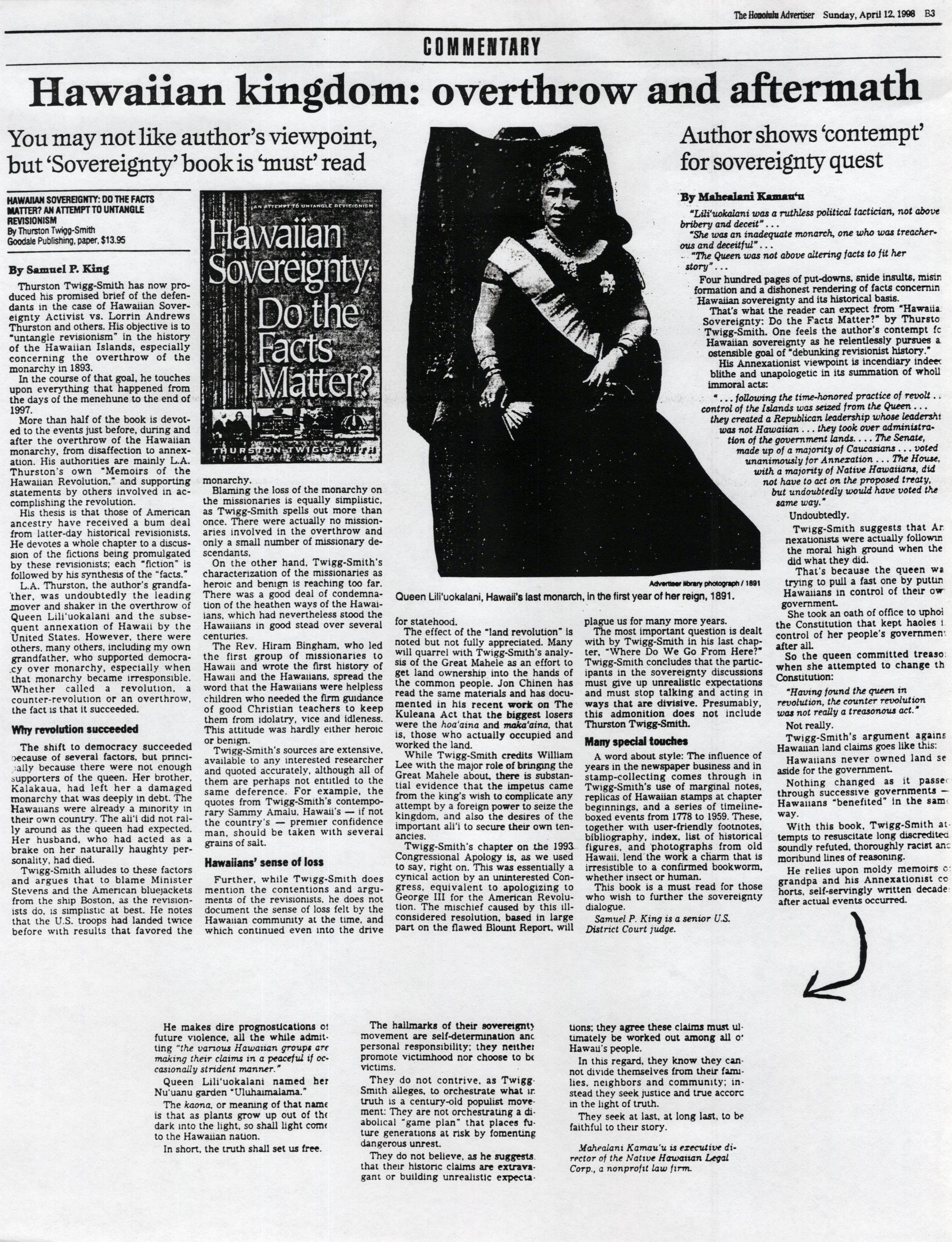
Companion commentary 1 of 9 — click to open full size 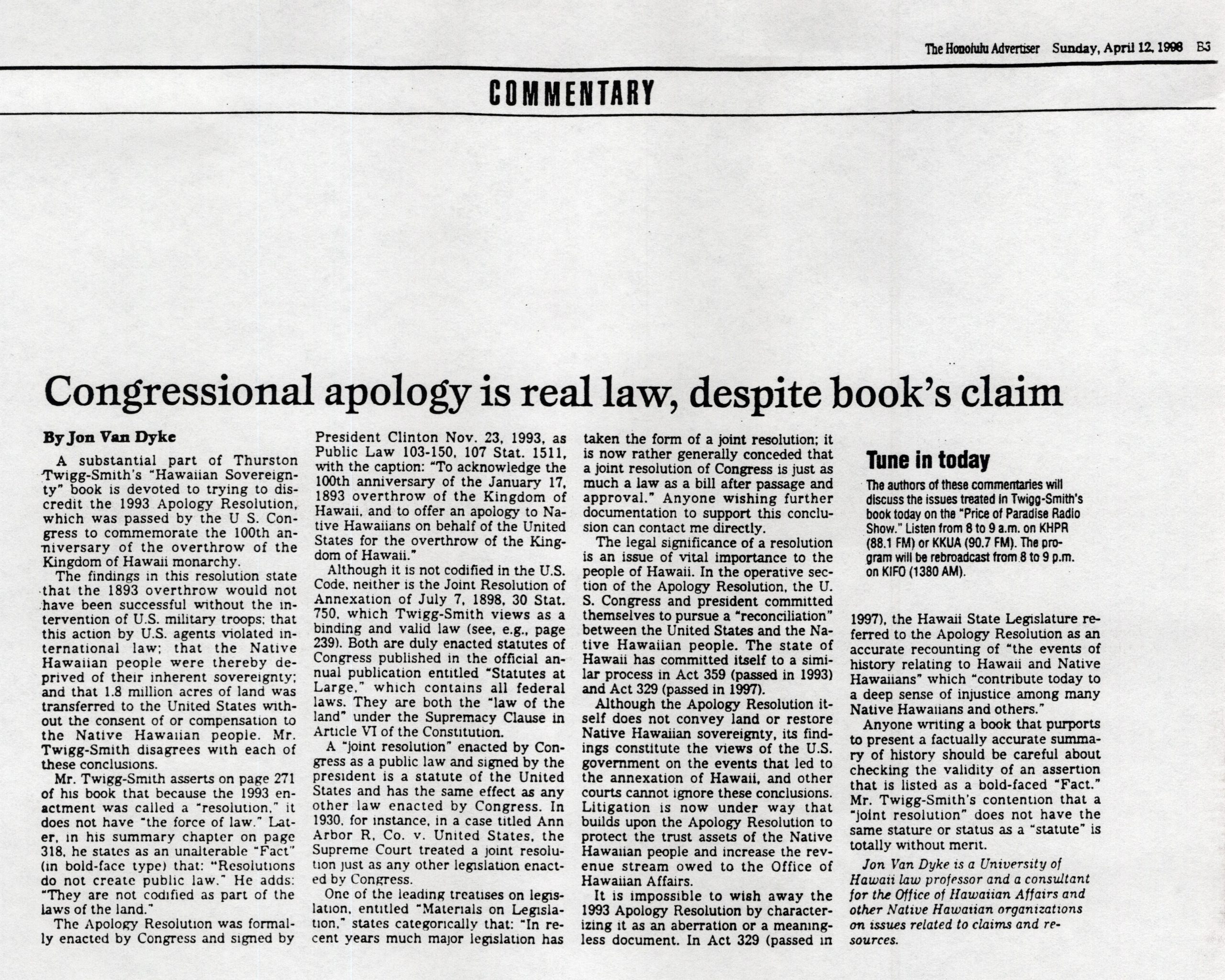
Companion commentary 2 of 9 — click to open full size 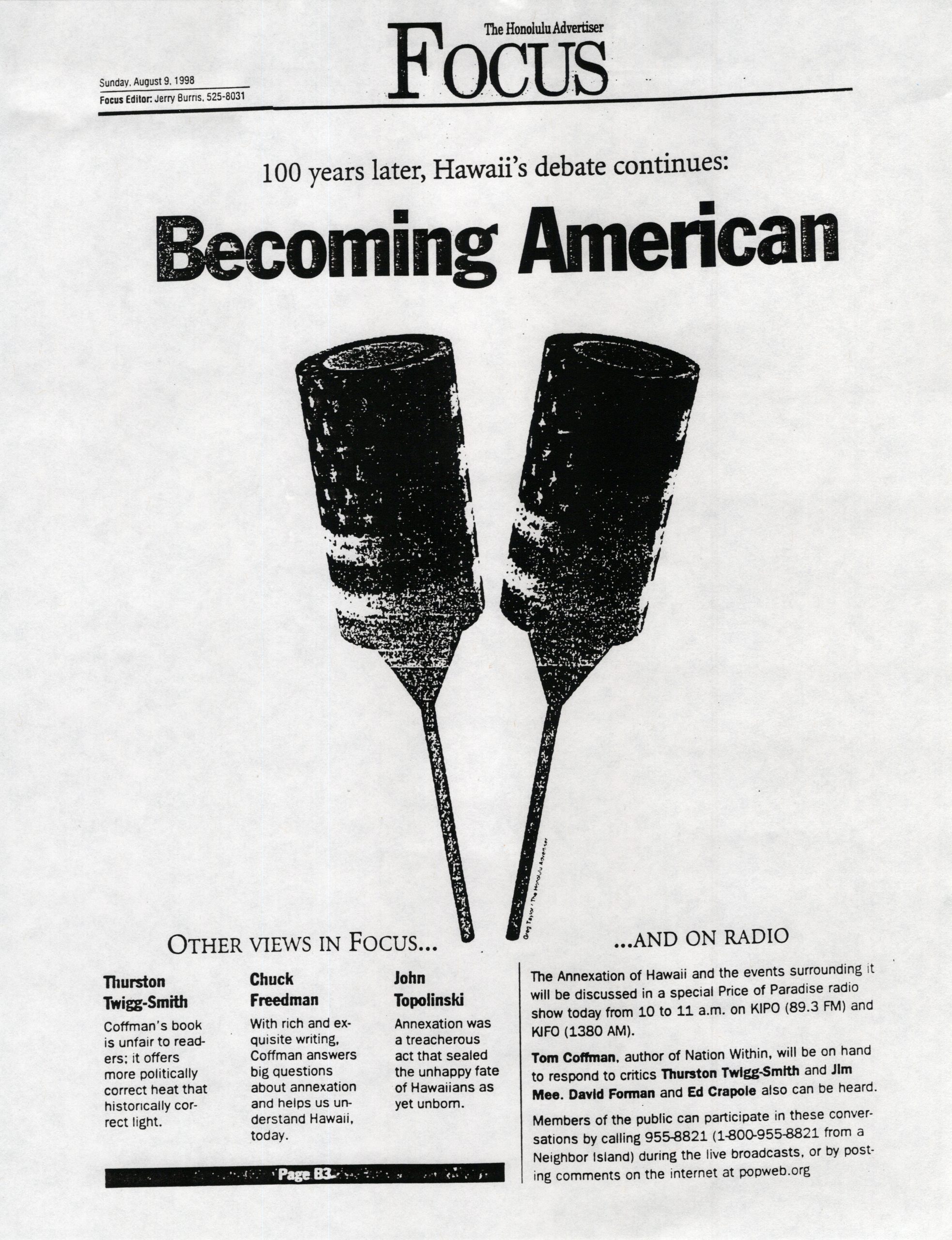
Companion commentary 3 of 9 — click to open full size 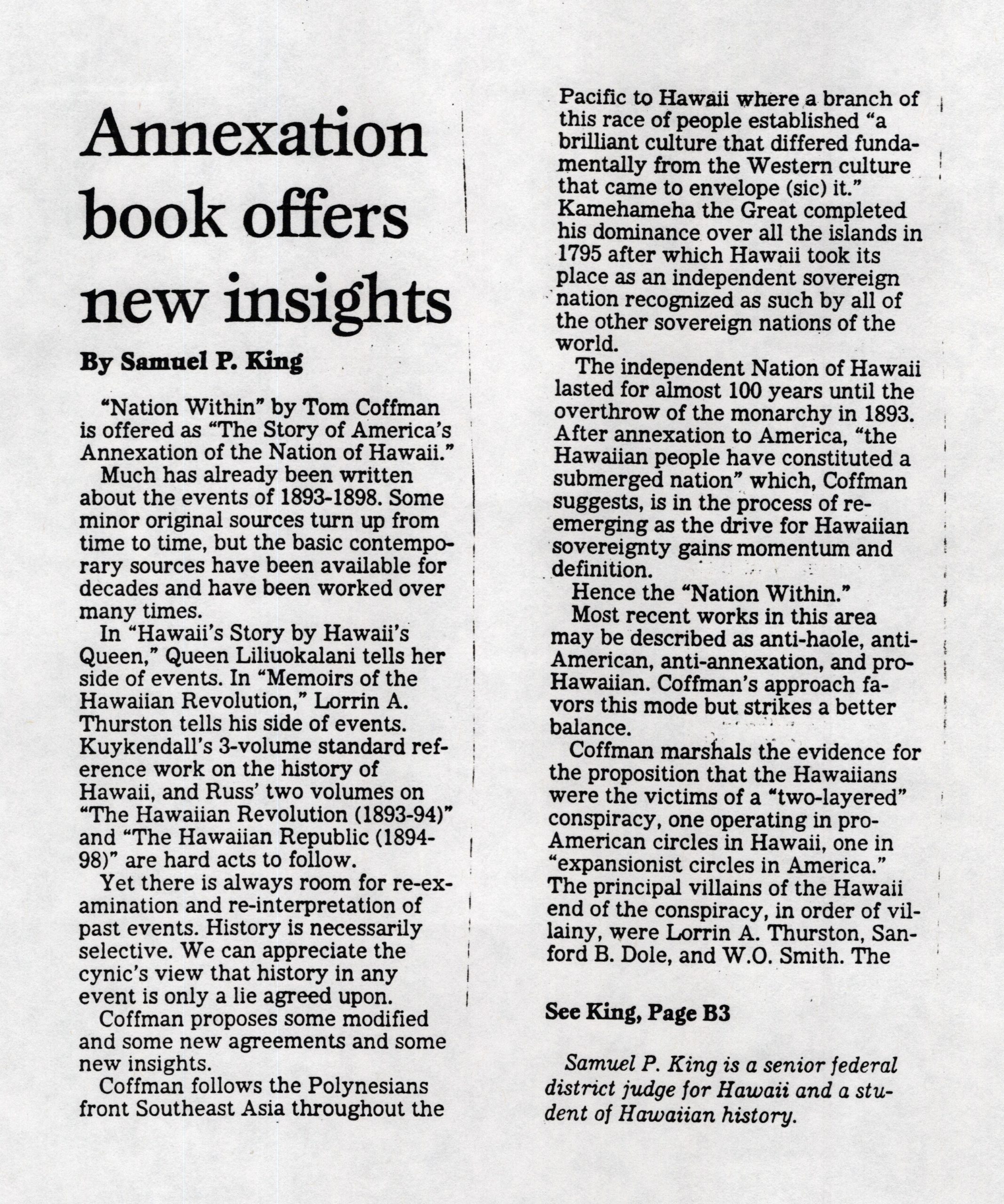
Companion commentary 4 of 9 — click to open full size 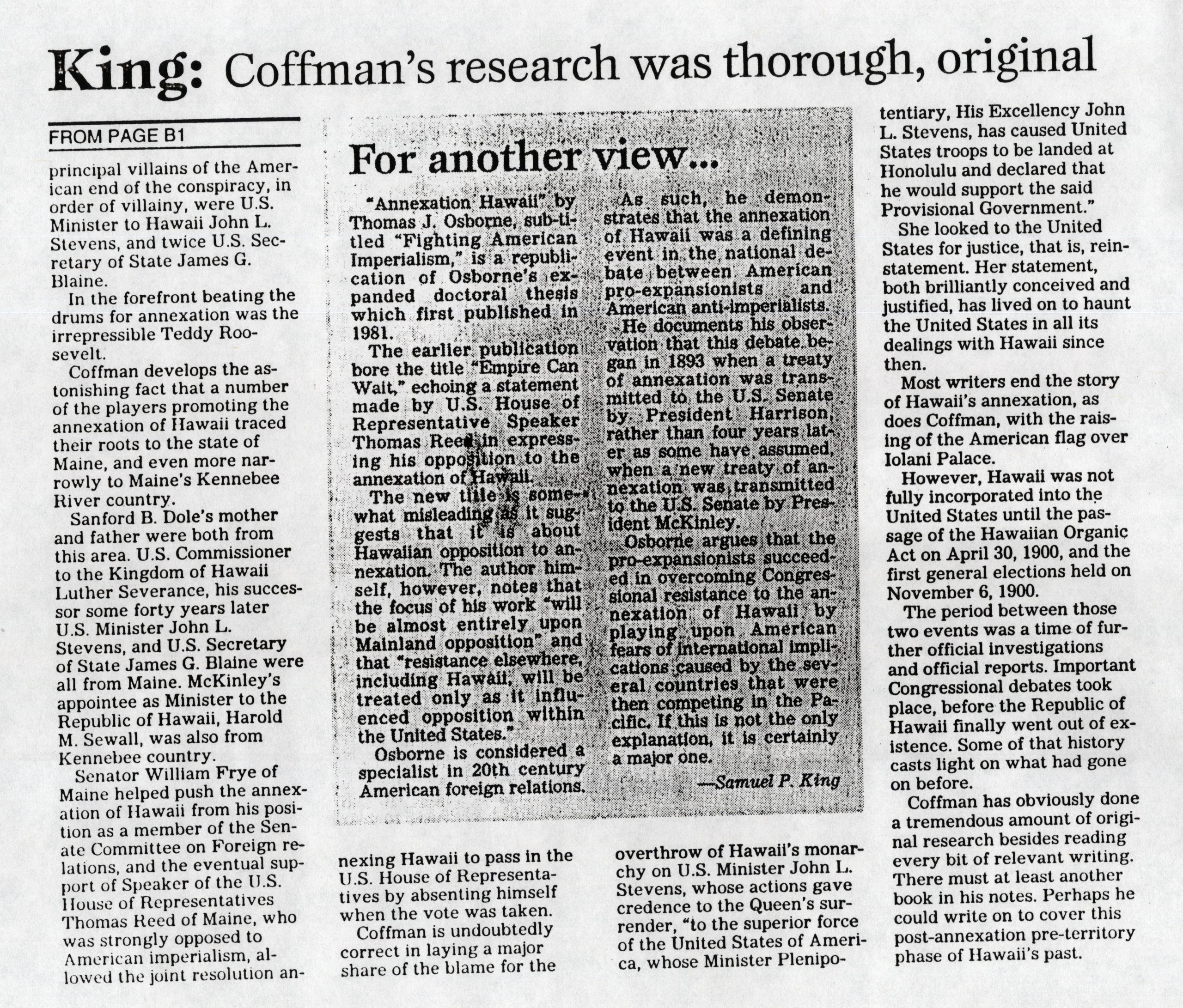
Companion commentary 5 of 9 — click to open full size 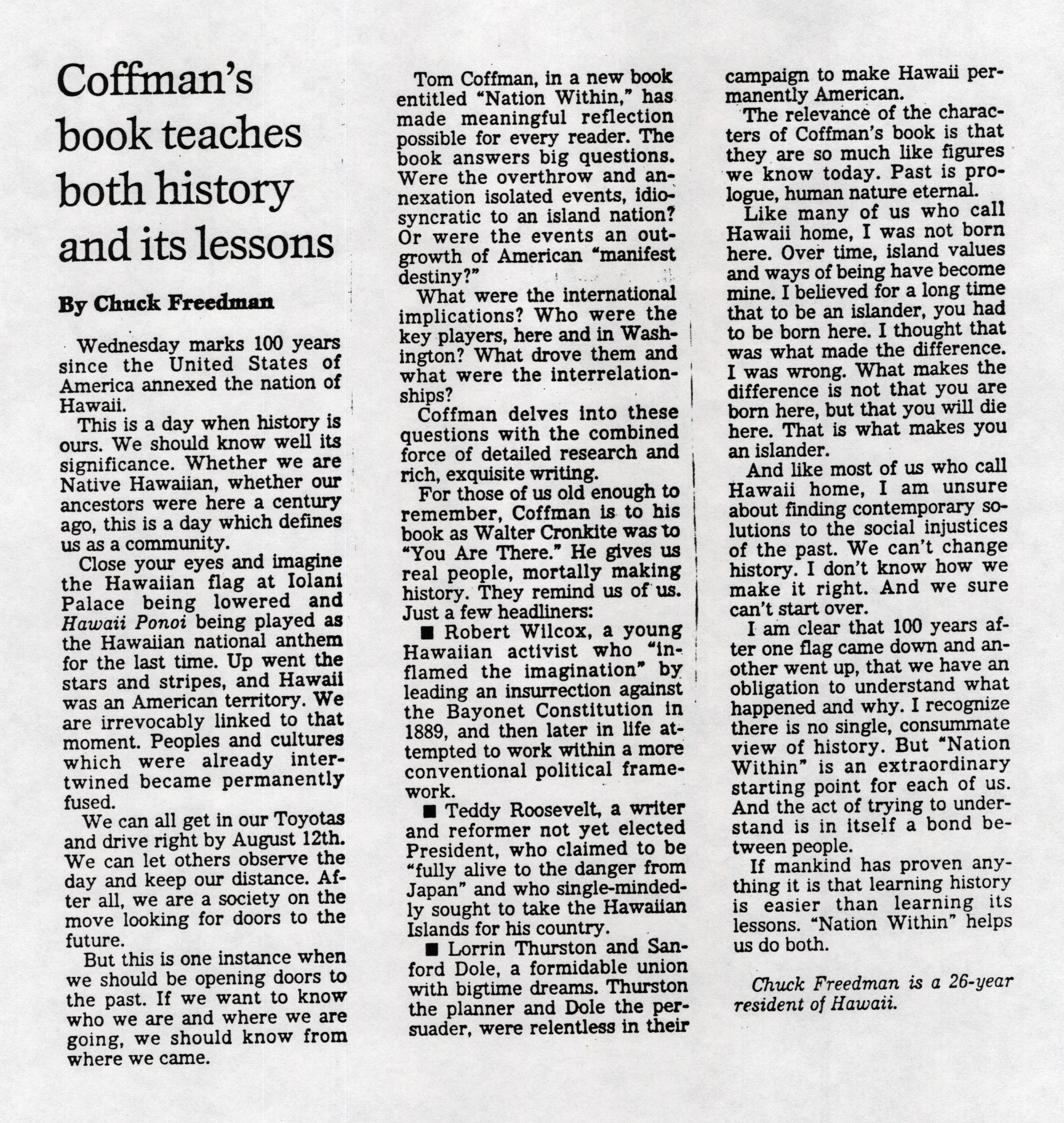
Companion commentary 6 of 9 — click to open full size 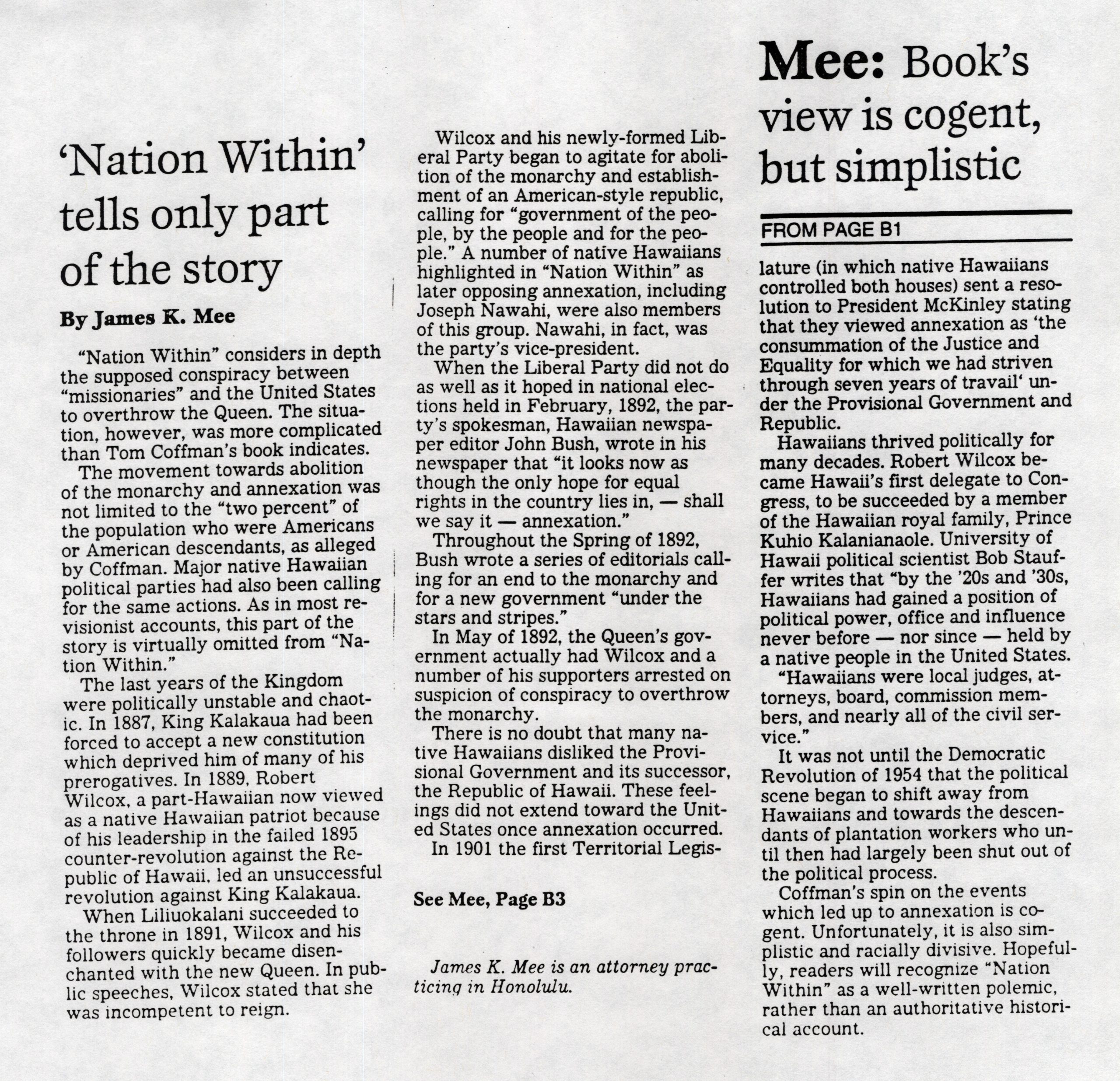
Companion commentary 7 of 9 — click to open full size 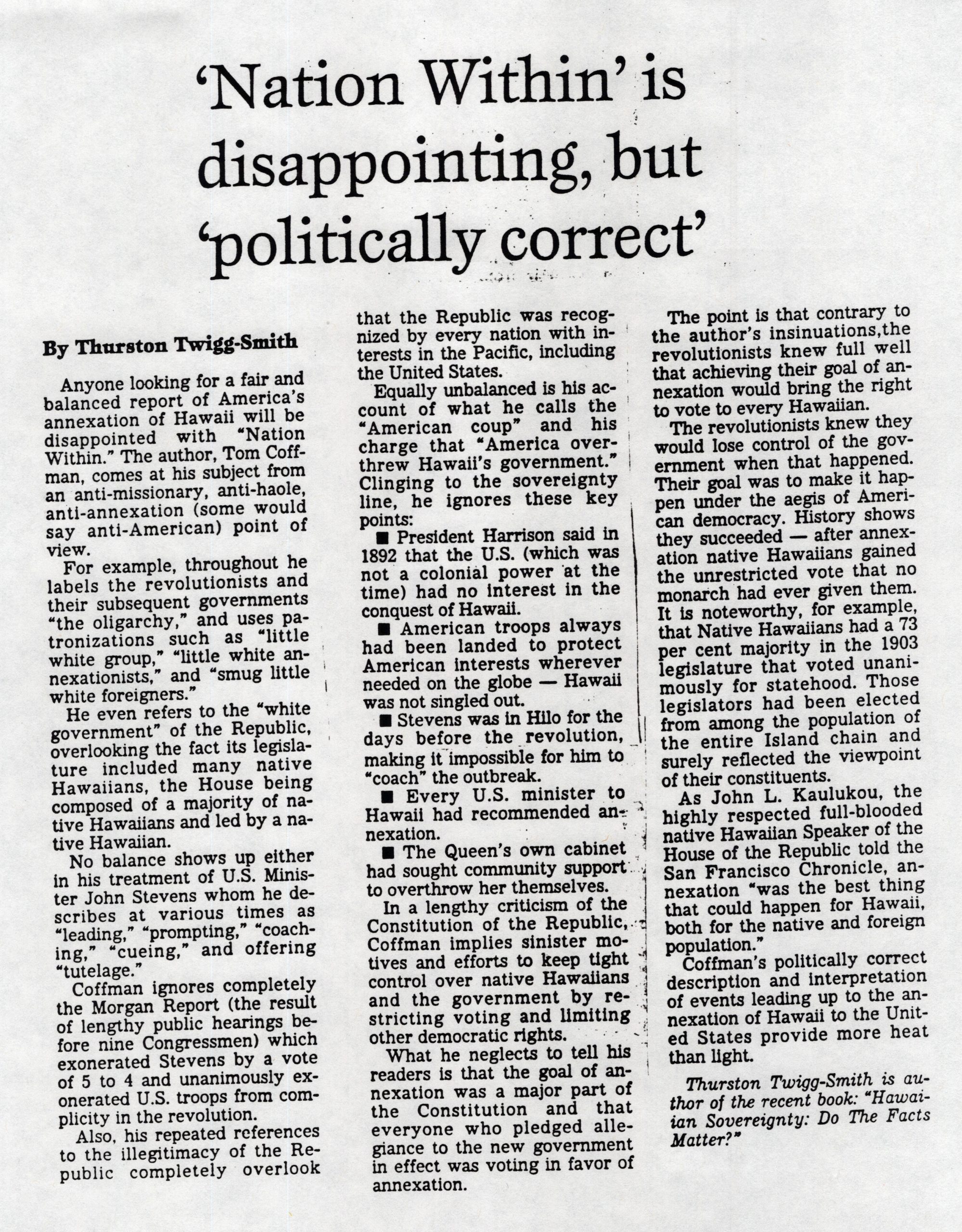
Companion commentary 8 of 9 — click to open full size 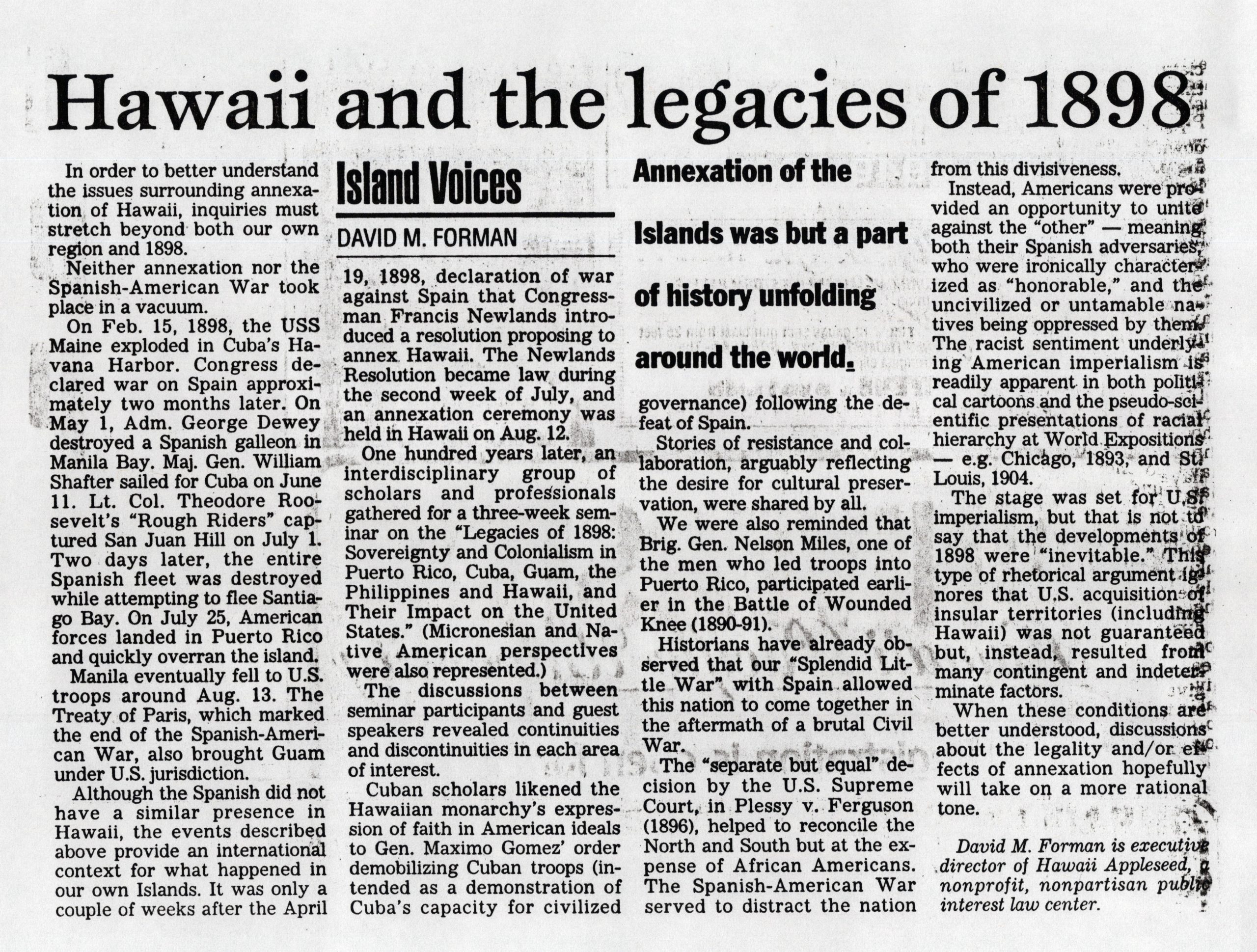
Companion commentary 9 of 9 — click to open full size The Native Hawaiian Vote
Two federal lawsuits challenging the recently completed native Hawaiian vote were pending before a federal judge when this programme brought together attorneys and a plaintiff from each side. John Goemans, lead counsel for non-Hawaiian plaintiff Harold Rice, argued that the state statute restricting participation to native Hawaiians imposed a racial qualification for voting prohibited by the Constitution, and that the Native American tribal election analogy did not apply. Haydon Aluli, representing two members of the Hawaiian Sovereignty Elections Council, countered that the state-run process was consistent with the 1993 federal Apology Resolution and its call for reconciliation. Lela Hubbard, a Hawaiian plaintiff in the separate Kalalea suit, supported sovereignty in principle but argued that the state of Hawaii lacked authority to organise the process; in her view, native Hawaiians should address their claims directly to the federal government. Jon Van Dyke, representing the Office of Hawaiian Affairs, argued that native Hawaiians hold a unique right to self-determination that has been denied to them alone among indigenous peoples in the United States. Whether race-restricted voting in a sovereignty election is constitutionally permissible is the question before the court.
Transcript
Read or download the full transcript (.txt). Speaker labels were assigned automatically and may contain errors.
Companion newspaper commentaries
Commentaries by the guests, published in The Honolulu Advertiser around the broadcast.
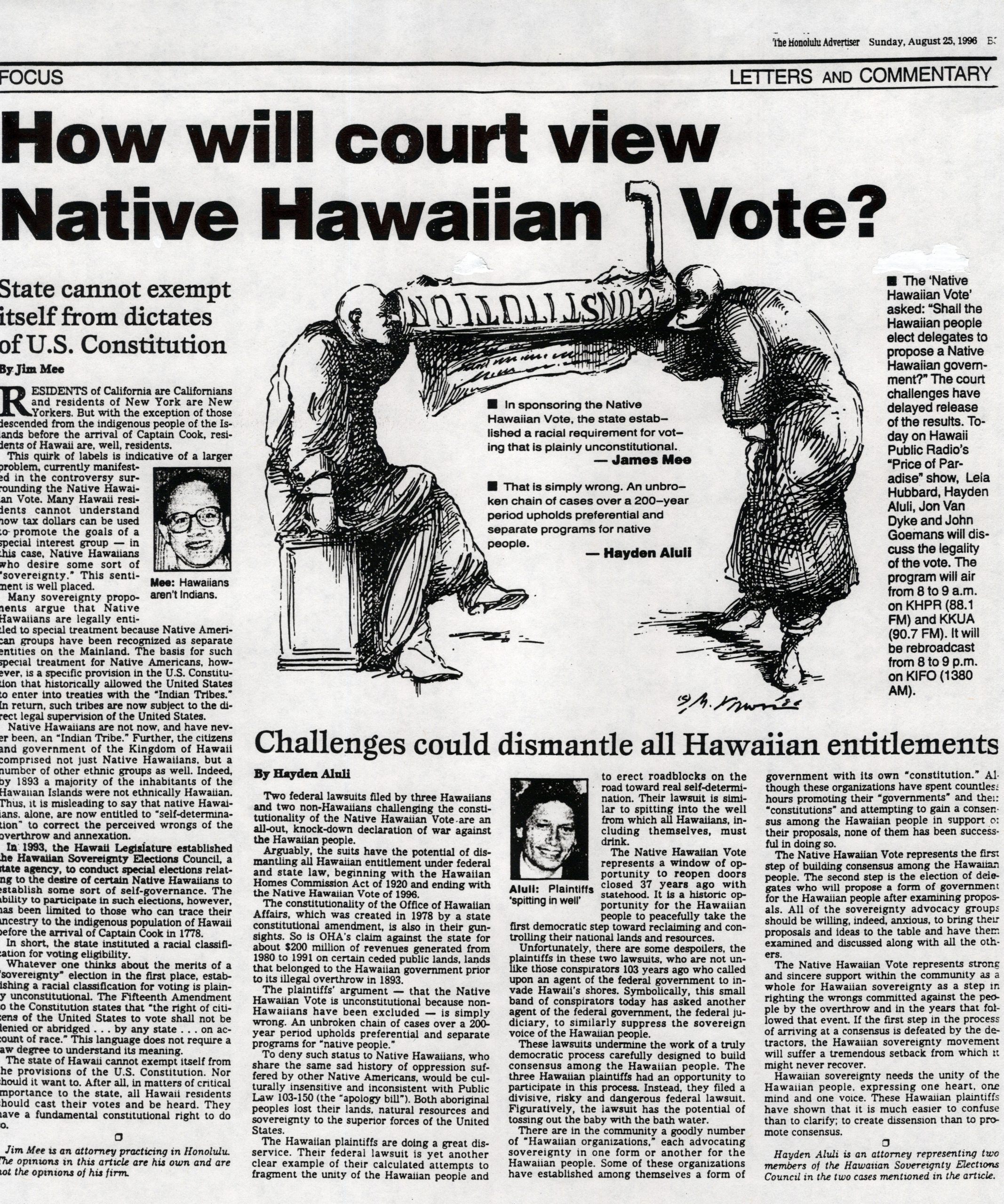
Companion commentary 1 of 1 — click to open full size Native Hawaiian Gathering Rights: The PASH Study Group Report
A Hawaii Supreme Court ruling that landowners cannot fully exclude native Hawaiians from traditional and customary access to land provided the context for this discussion of the decision's implications and the work of a study group charged with proposing a path forward. Walter Heen, a retired judge of the Intermediate Court of Appeals who heard the PASH case at that level, traced the legal path from a narrow standing dispute to a Supreme Court opinion he described as a substantial expansion into questions of title. Dan Davidson, executive director of the Land Use Research Foundation of Hawaii, acknowledged that the development community accepted the ruling but pressed for clearer legal standards, as uncertainty over the scope of gathering rights was creating difficulties for land transactions and planning. Hannah K. Springer, a trustee of the Office of Hawaiian Affairs speaking as a native practitioner, argued that gathering rights are integral to Hawaiian cultural continuity and that existing constitutional and statutory protections need only be implemented, not revised. All three guests had served on the PASH study group, whose report had just been submitted to a state legislative committee.
Transcript
Read or download the full transcript (.txt). Speaker labels were assigned automatically and may contain errors.
Companion newspaper commentaries
Commentaries by the guests, published in The Honolulu Advertiser around the broadcast.
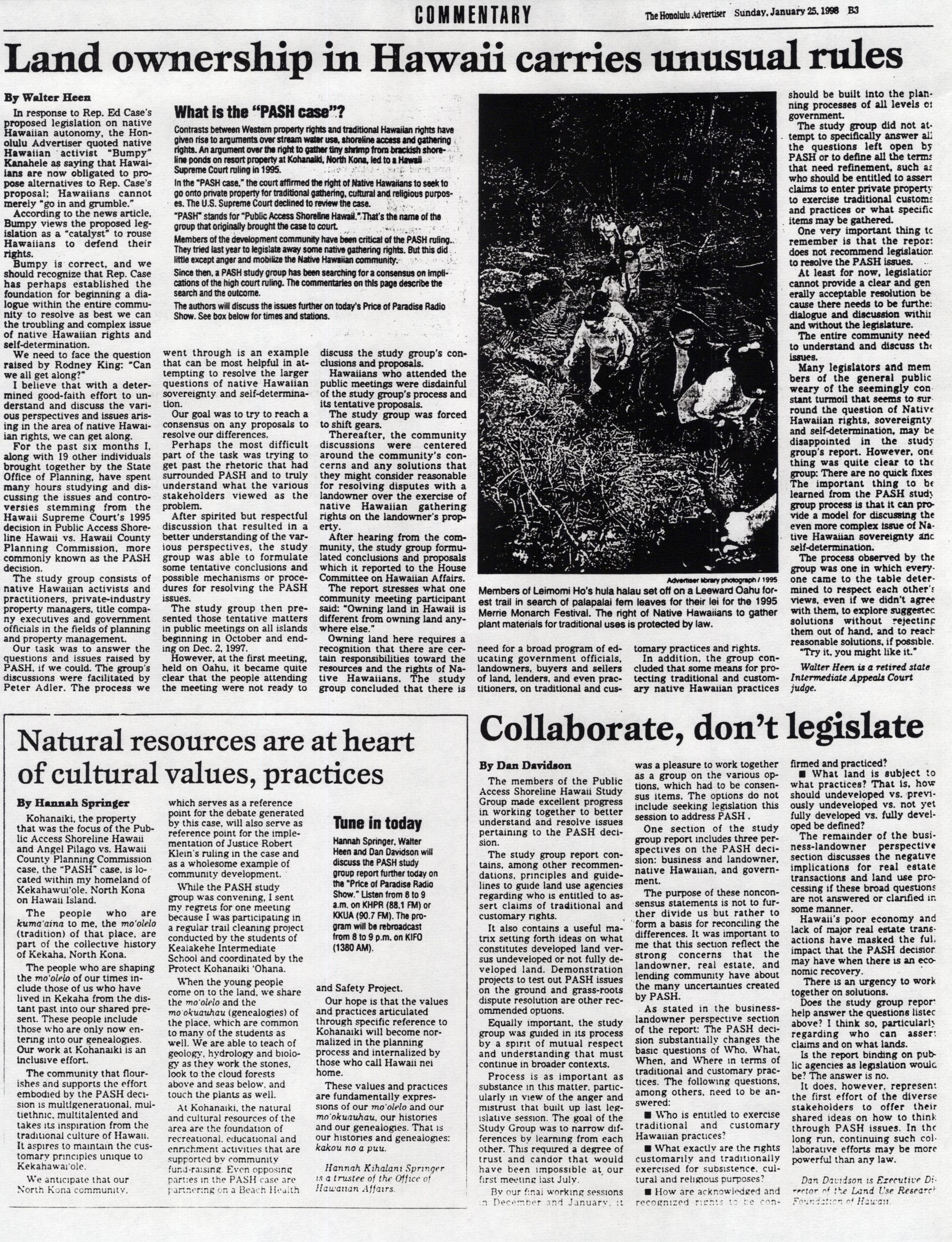
Companion commentary 1 of 1 — click to open full size Hawaiian Autonomy I
Ed Case, state representative and chair of the House Committee on Hawaiian Affairs, proposed the Native Hawaiian Autonomy Act in January 1998. The bill sought to coordinate Hawaiian state agencies, advance self-determination, and settle ceded land claims; Case argued it was needed to move a stalled debate forward, though he had developed it without prior consultation with Hawaiian organizations. Kali Watson, chairman of the Hawaiian Homes Commission, accepted the goal of autonomy but raised objections to the bill's effects on federal loan programs, water rights, and blood quantum requirements. Mililani B. Trask, governor of Ka Lāhui Hawaiʻi, called the bill racist and argued it substituted a corporate nonprofit structure for genuine sovereignty. Kinau Kamaliʻi, former state legislator and former Office of Hawaiian Affairs trustee, urged Case to withdraw and engage Hawaiian communities first. Attorney William Meheula warned that the bill could enable premature settlement of ceded land claims without Hawaiian representation. A. Frenchy DeSoto, chair of the Office of Hawaiian Affairs, called the bill dangerous. Case replied he intended to introduce but not report it out of committee. The central question is whether autonomy within the state framework, as opposed to full sovereignty, is a legitimate path for Native Hawaiians.
Transcript
Read or download the full transcript (.txt). Speaker labels were assigned automatically and may contain errors.
Companion newspaper commentaries
Commentaries by the guests, published in The Honolulu Advertiser around the broadcast.
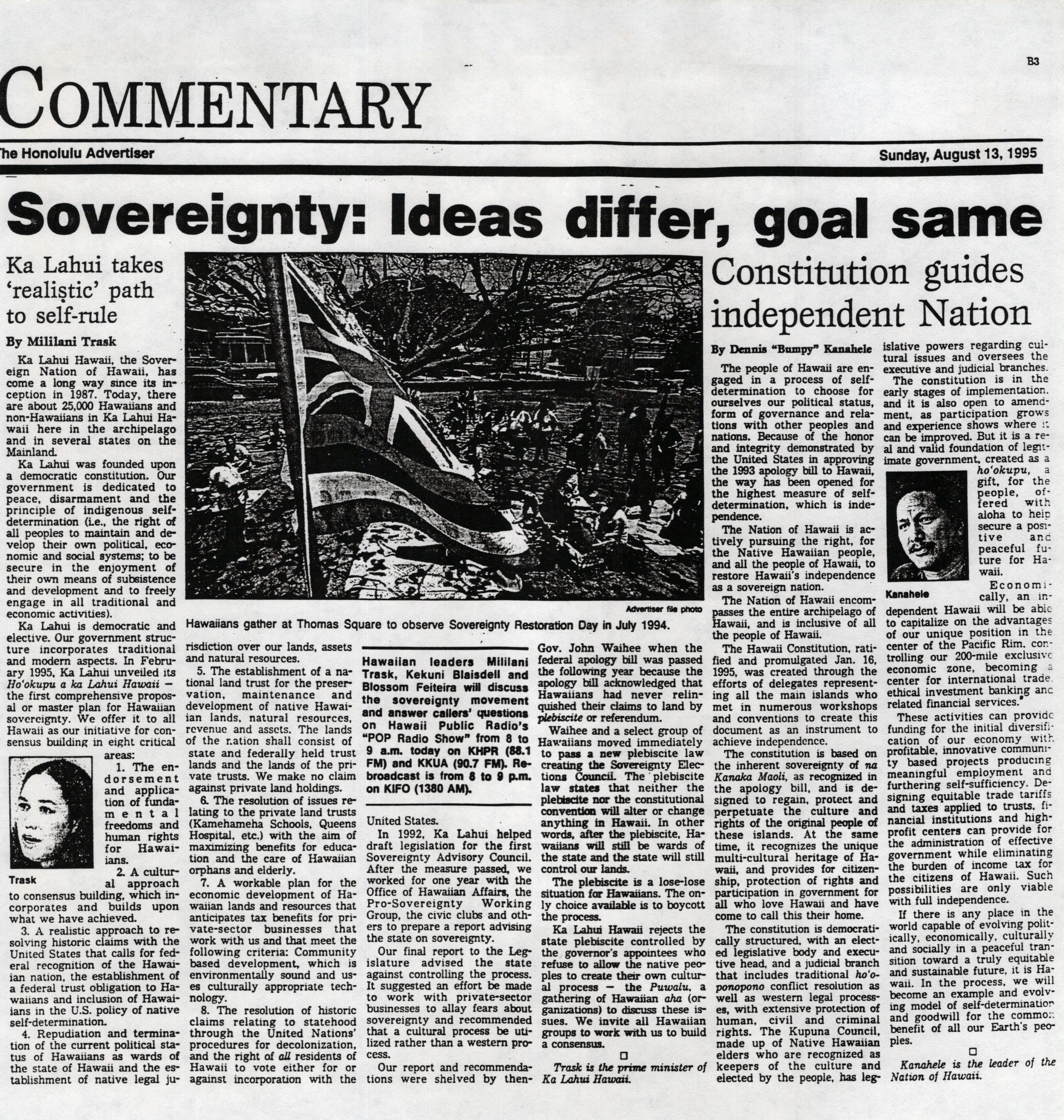
Companion commentary 1 of 3 — click to open full size 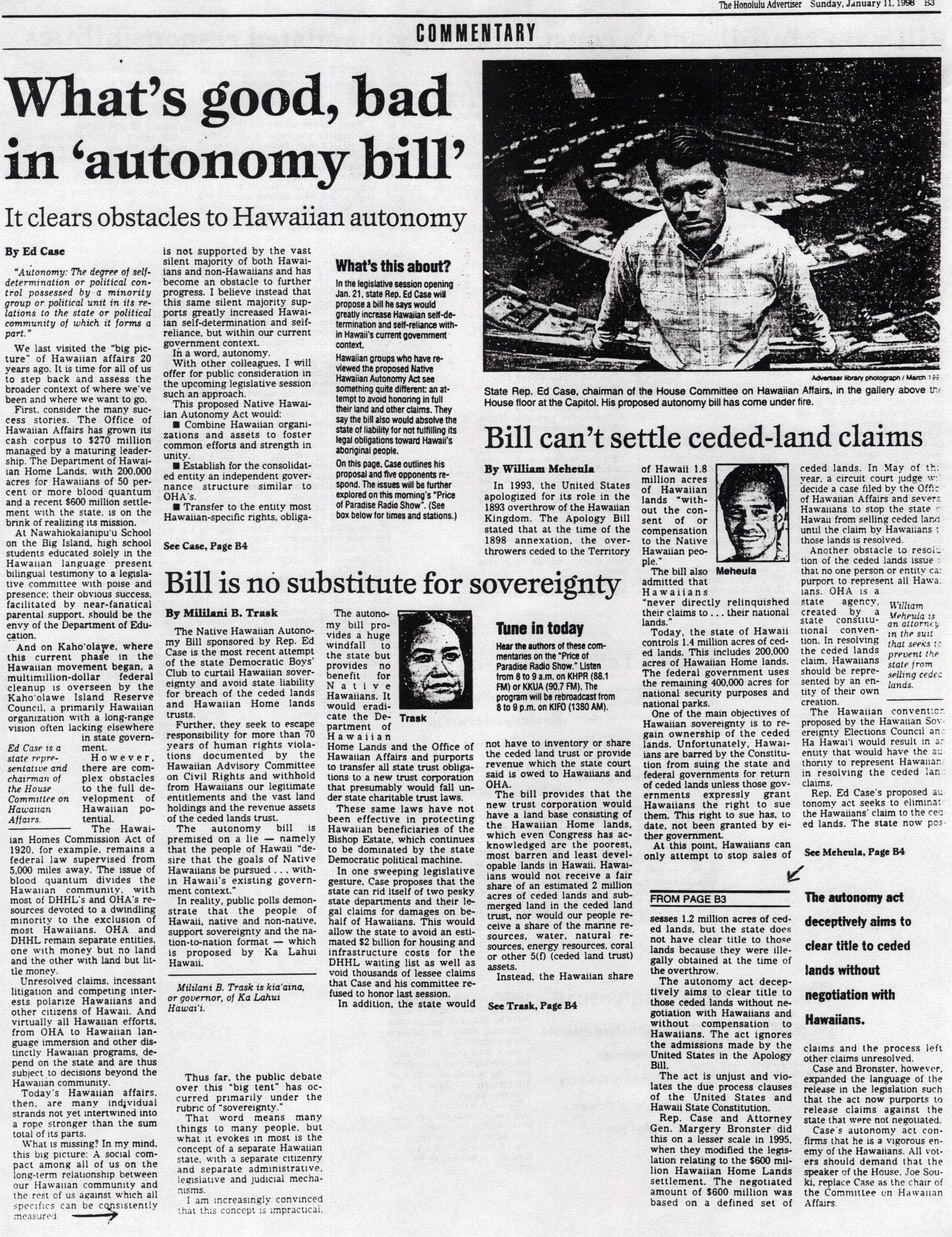
Companion commentary 2 of 3 — click to open full size 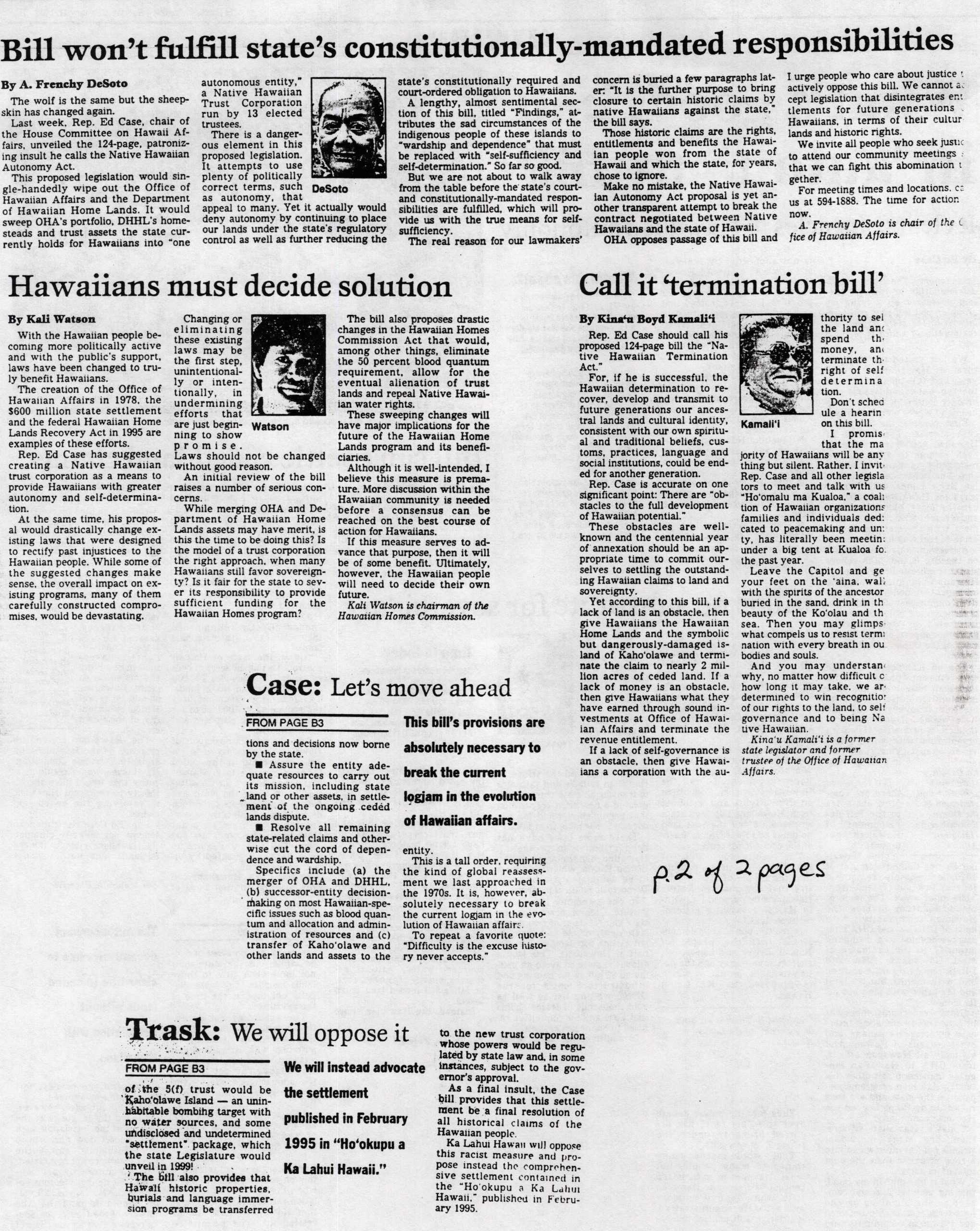
Companion commentary 3 of 3 — click to open full size Ethnic Relations: Are We Getting Along?
A newspaper poll showing most Hawaii residents believed their communities got along well prompted this May 1996 broadcast, in which four academic guests and a live studio audience of high school students examined that claim. Jonathan Okamura, a University of Hawaii ethnic studies researcher, argued that Hawaii's reputation for harmonious race relations obscured persistent inequities in power and economic opportunity, and that racism and institutional discrimination remained inadequately addressed. Peter Manicas, a philosopher at UH Mānoa who identified himself as a mainland haole, contended that earlier social peace had rested on passive acceptance of subordinate positions, and that the Hawaiian sovereignty movement expressed legitimate grievance rather than mere conflict. Davianna Pōmaikaʻi McGregor, a professor of ethnic studies, said Native Hawaiians were seeking to remedy longstanding economic disparities through self-governance and land repatriation. Attorney James Mee, also a studio guest, expressed concern that the sovereignty movement risked generating community backlash and deepening divisions if not pursued carefully. The question is whether Hawaii's ethnic diversity constitutes genuine equality or a surface calm built on unequal terms.
Transcript
Read or download the full transcript (.txt). Speaker labels were assigned automatically and may contain errors.
Companion newspaper commentaries
Commentaries by the guests, published in The Honolulu Advertiser around the broadcast.
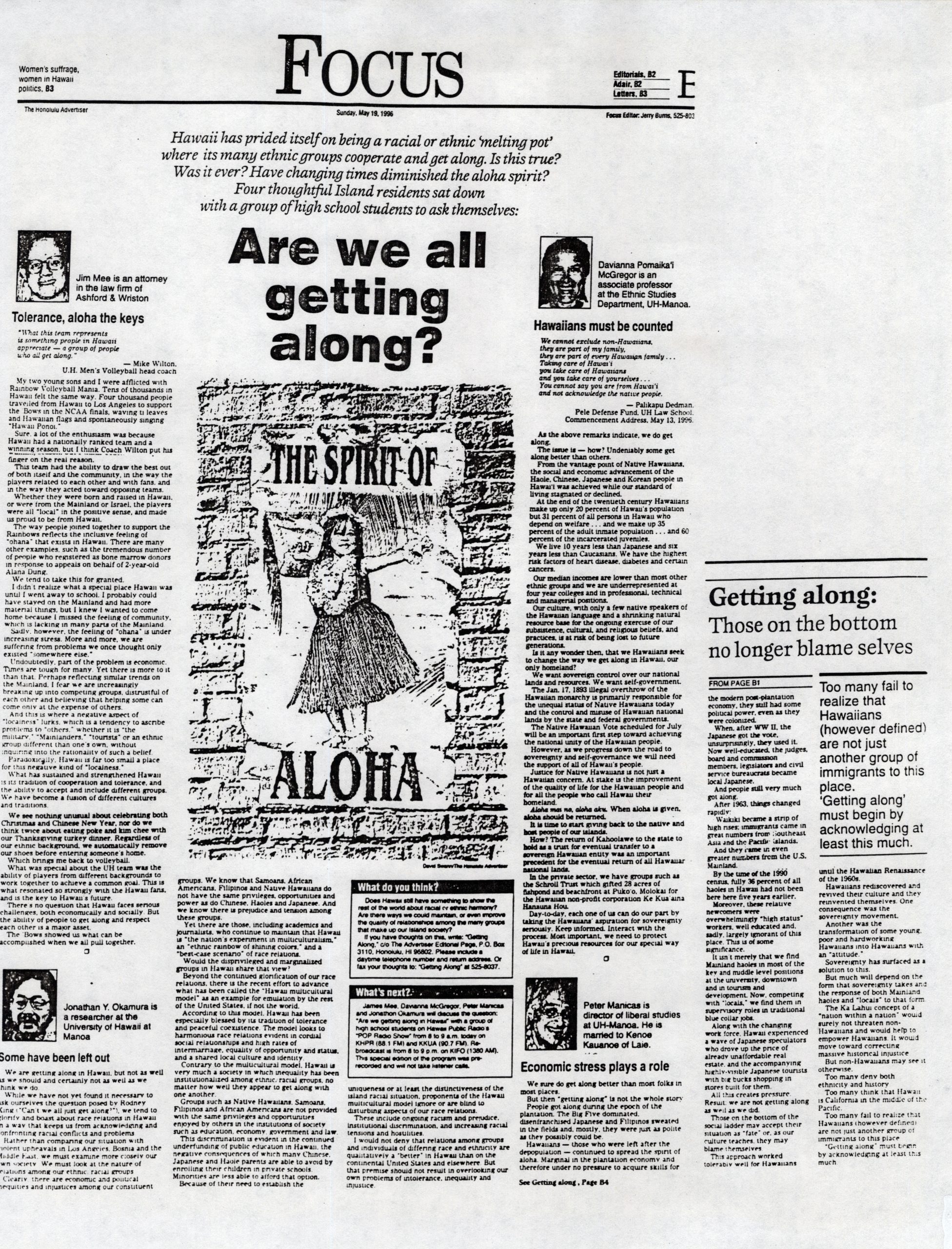
Companion commentary 1 of 1 — click to open full size Political Corruption
Recorded in November 1993, this episode examined claims of systematic political corruption and retaliation in Hawaii's state government. State Senator Richard Matsuura, then chairing a special Senate committee investigating government misconduct, described what he called total administrative control of the legislature by a small group of insiders—informally called a Council of Elders—who used committee appointments, contract awards, and pension arrangements to enforce loyalty and punish dissent. Matsuura said he had been stripped of committee chairmanships as punishment for pursuing the investigation, and reported receiving anonymous calls from constituents too afraid of retaliation to identify themselves. Bob Rees, an instructor of business and American studies at the University of Hawaii, agreed that a democratic oligarchy had emerged, attributing it to decades of single-party rule and the arbitrary exercise of government economic power. Both guests described the High Three pension arrangement—under which legislators appointed to high-paying state jobs saw their pensions increase dramatically—as a mechanism rewarding political compliance. Matsuura noted his committee was running out of funds and nearing closure. Whether Hawaii's entrenched political structures can be reformed from within is the question the episode raises.
Transcript
Read or download the full transcript (.txt). Speaker labels were assigned automatically and may contain errors.
Companion newspaper commentaries
Commentaries by the guests, published in The Honolulu Advertiser around the broadcast.
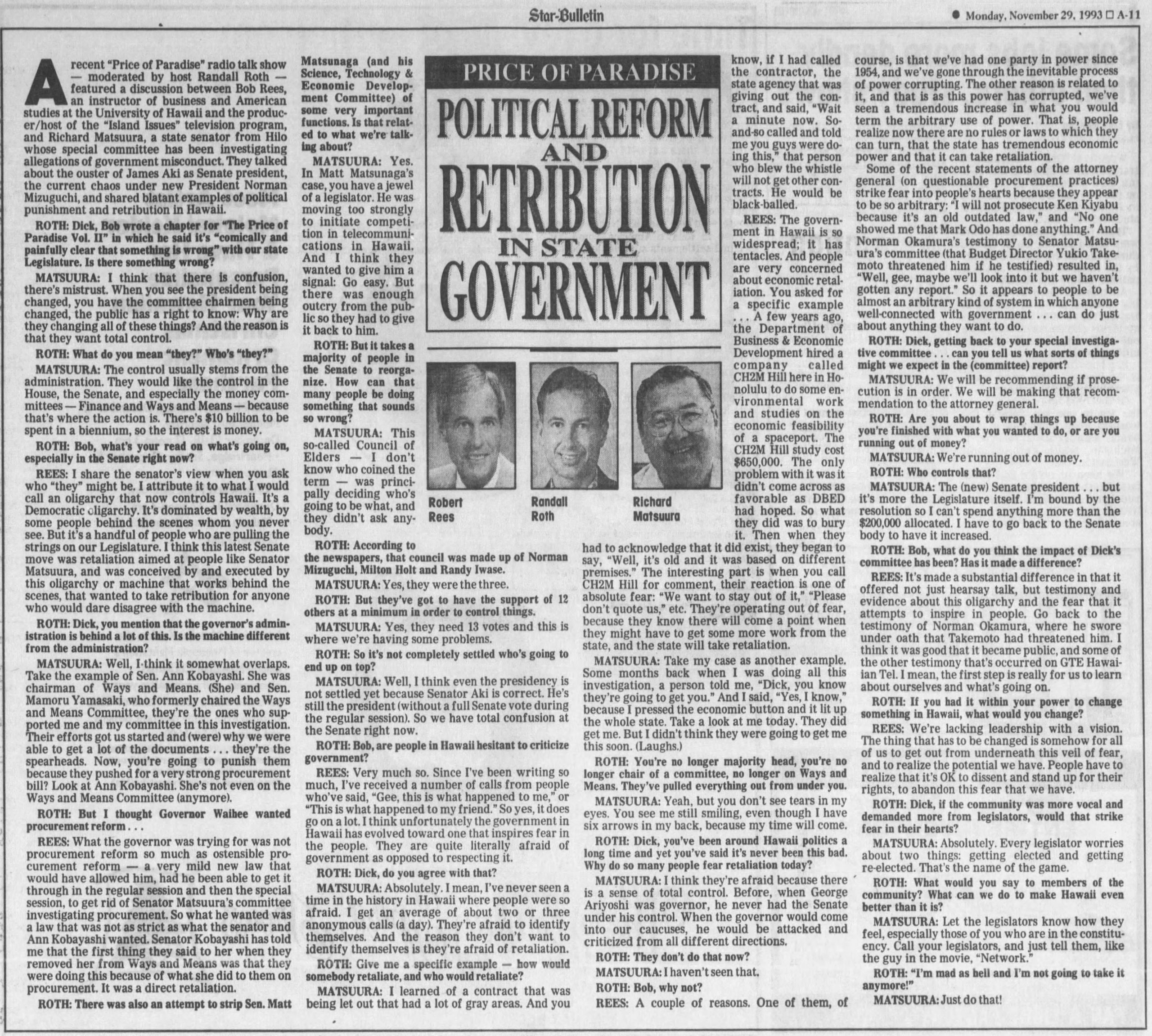
Companion commentary 1 of 2 — click to open full size Companion commentary 2 of 2 — click to open full size Campaign Finance Concerns
Topic: Politics & GovernmentEight guests debated campaign finance in Hawaii in this March 1996 broadcast, examining whether political contributions corrupt the legislative process. Bob Watada, executive director of the Campaign Spending Commission, described the state's disclosure requirements as a sound foundation and noted that the 1995 legislature had expanded his agency's enforcement capacity. Don Clegg, a former city planning director, argued that Honolulu's local campaign assistance ordinance was unconstitutional and so broadly drawn that it discouraged civic participation. Neal Milner, a University of Hawaii political scientist, doubted that full public financing of elections was fiscally realistic. Kioni Dudley, head of the Hawaii Green Party, contended that public financing was both feasible and necessary, arguing that private contributions gave large donors disproportionate access to legislators. Lobbyist Red Morris maintained that disclosure was sufficient and that contributions did not demonstrably purchase specific legislative outcomes. Arleen Kim Ellis of the League of Women Voters advocated voluntary spending limits paired with public incentives to reduce the fundraising advantage incumbents hold over challengers. Desmond Byrne of Common Cause Hawaii and State Senator Mary George also contributed. The question is whether disclosure alone protects the integrity of Hawaii's elections, or whether tighter contribution limits and public financing are required.
Transcript
Read or download the full transcript (.txt). Speaker labels were assigned automatically and may contain errors.
Companion newspaper commentaries
Commentaries by the guests, published in The Honolulu Advertiser around the broadcast.
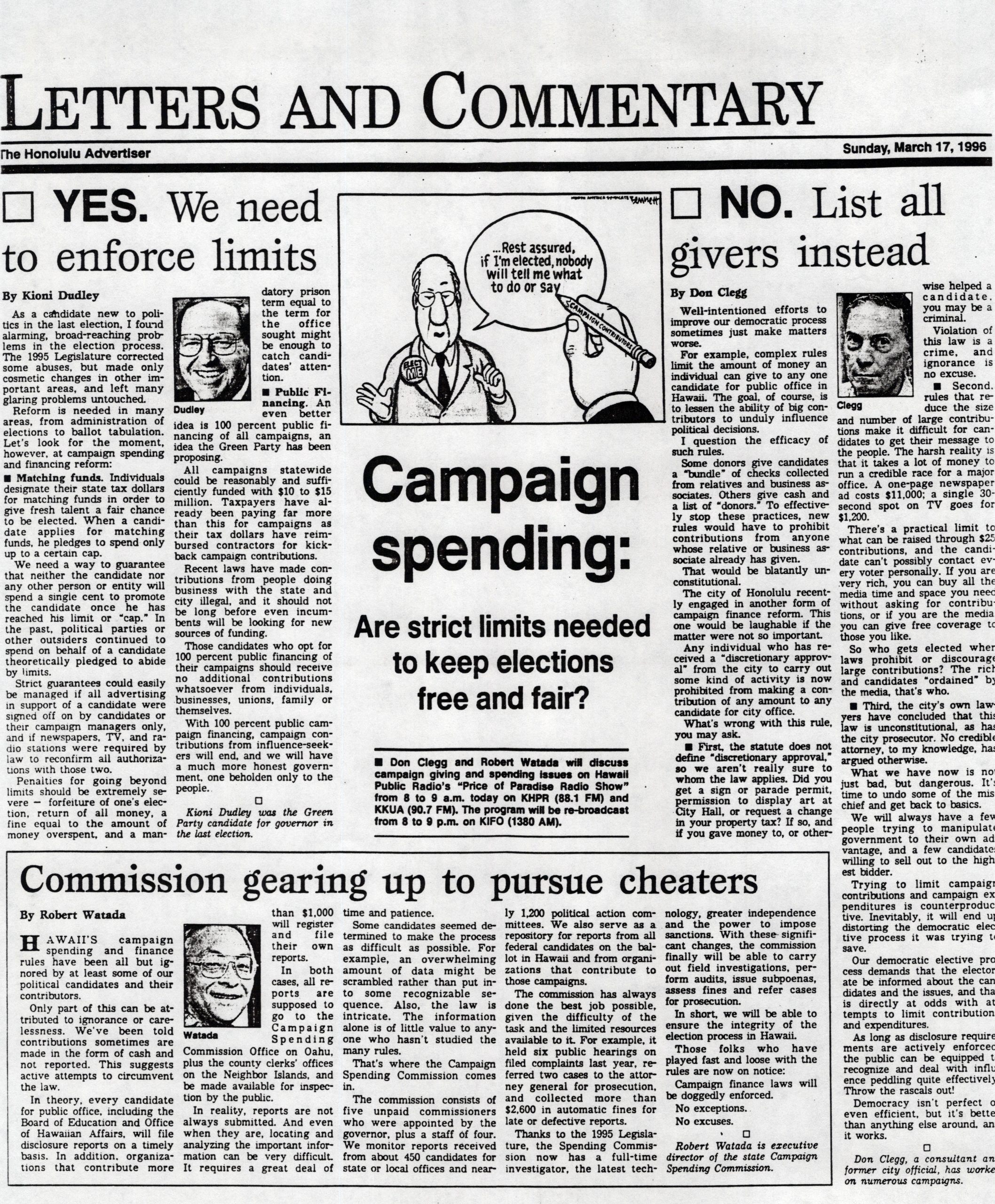
Companion commentary 1 of 1 — click to open full size Campaign Finance Reform
Topic: Politics & GovernmentTwo years after a 1996 Price of Paradise broadcast on the same subject, this June 1998 episode examined specific proposals for reforming Hawaii's campaign finance system. Janet Mason, vice president of the League of Women Voters of Honolulu, argued that money effectively determines electoral outcomes and proposed a voluntary Clean Money arrangement under which candidates who gathered a minimum number of small donations would qualify for modest public funding and agree to forego large private contributions. She cited research suggesting that when spending ratios stayed within two to one, incumbents and challengers competed on roughly equal terms. Ken Schoolland, a professor of economics and political science at Hawaii Pacific University, rejected the proposal as both ineffective and objectionable in principle, arguing that public funding compels taxpayers to finance political opinions they oppose; he preferred reducing the regulatory scope of government so that officeholders had fewer favors to sell. Bob Watada, executive director of the Campaign Spending Commission, described existing contribution limits and reported that the state's public election fund held roughly four million dollars that had gone largely unused. Whether a voluntary public financing system can meaningfully reduce the influence of private money in Hawaii's elections is the central dispute.
Transcript
Read or download the full transcript (.txt). Speaker labels were assigned automatically and may contain errors.
Companion newspaper commentaries
Commentaries by the guests, published in The Honolulu Advertiser around the broadcast.
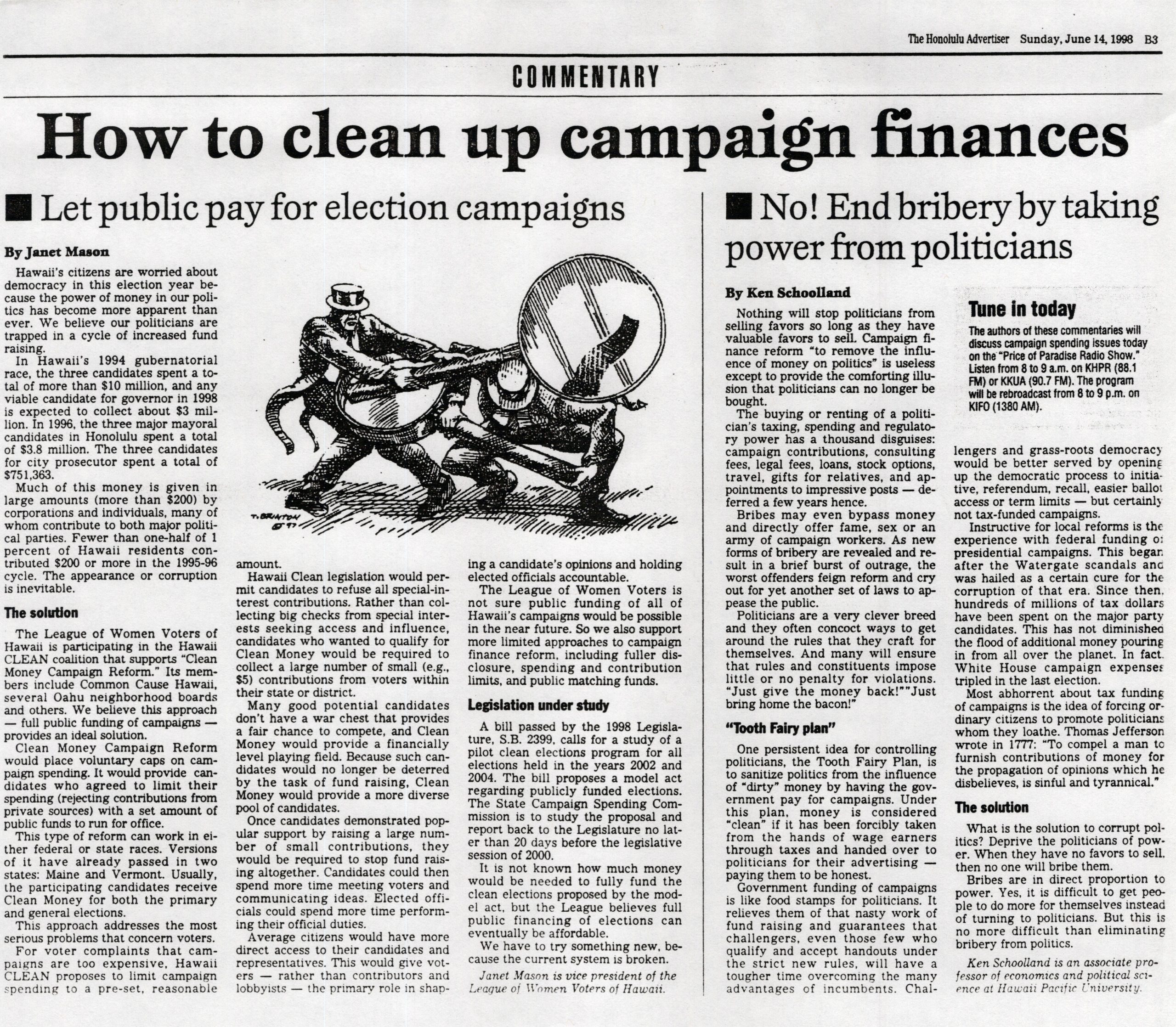
Companion commentary 1 of 1 — click to open full size
