1X
Three University of Hawaii professors examined what global warming might mean for the Hawaiian Islands. The central question is whether the documented rise in global temperatures — roughly one to two degrees Fahrenheit over the past century — will produce significant consequences for Hawaii's coastlines, water supply, ecosystems, and severe weather. Fred Mackenzie, a professor of oceanography, confirmed that temperatures are rising at a rate somewhat faster than natural variability would suggest and noted evidence of ozone depletion above Hawaii, including unusually low ozone levels recorded in the winter of 1994. Tom Giambelluca, a climatologist, described sea level rise as a concern for the coming century, with estimates ranging from less than four inches to several feet, driven principally by the thermal expansion of ocean water rather than ice-cap melting. Tom Schroeder, a meteorologist, cautioned against assuming that warmer ocean temperatures would simply produce more or stronger hurricanes, explaining that cyclone formation requires six concurrent factors and that climate models had produced inconclusive results on this point. All three agreed that warming is occurring; the debate centred on the degree of scientific uncertainty surrounding its local effects on precipitation, biodiversity, and extreme weather events.
Transcript
Read or download the full transcript (.txt). Speaker labels were assigned automatically and may contain errors.
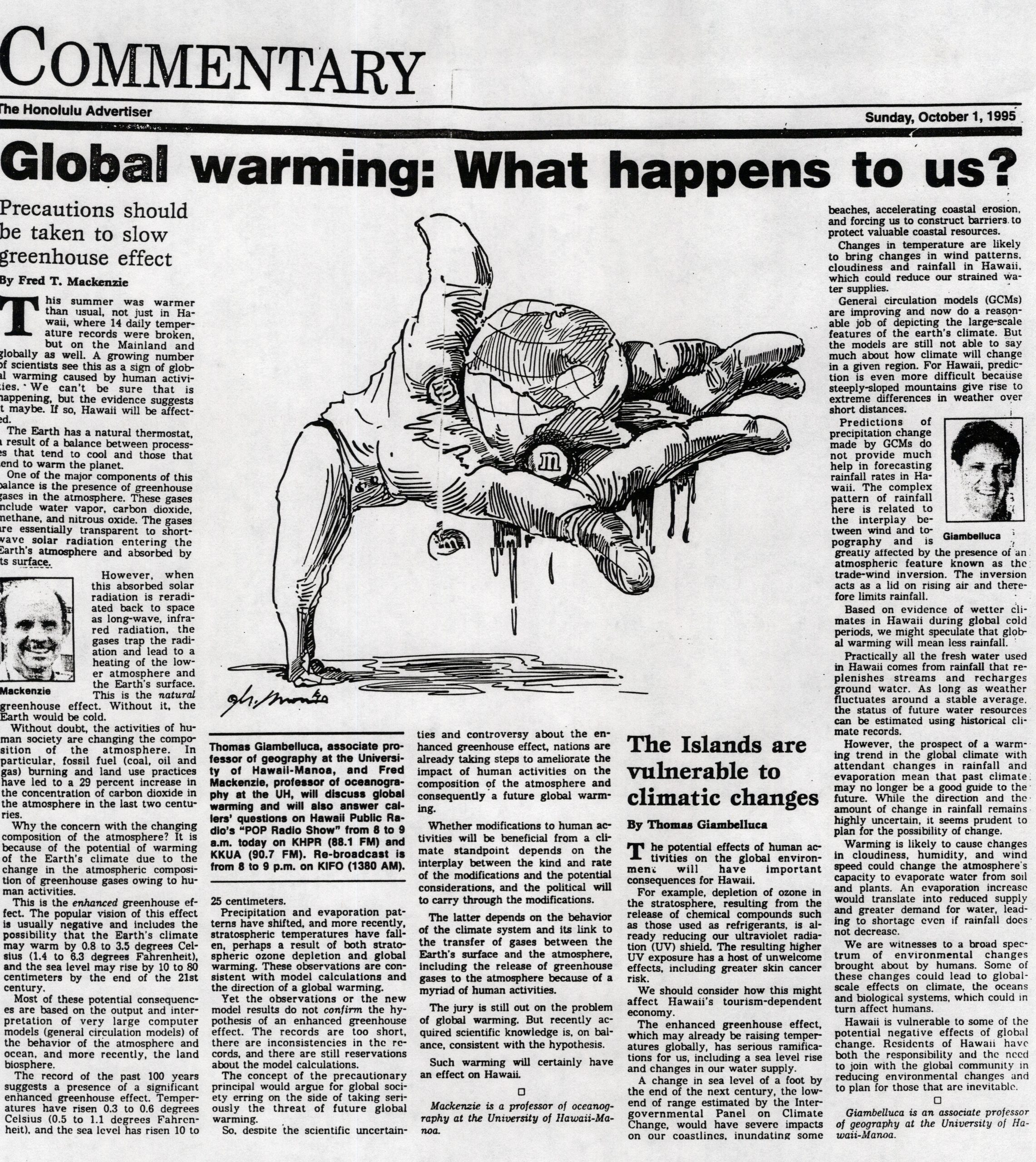
Companion newspaper commentaries
Commentaries by the guests, published in The Honolulu Advertiser around the broadcast.