1X
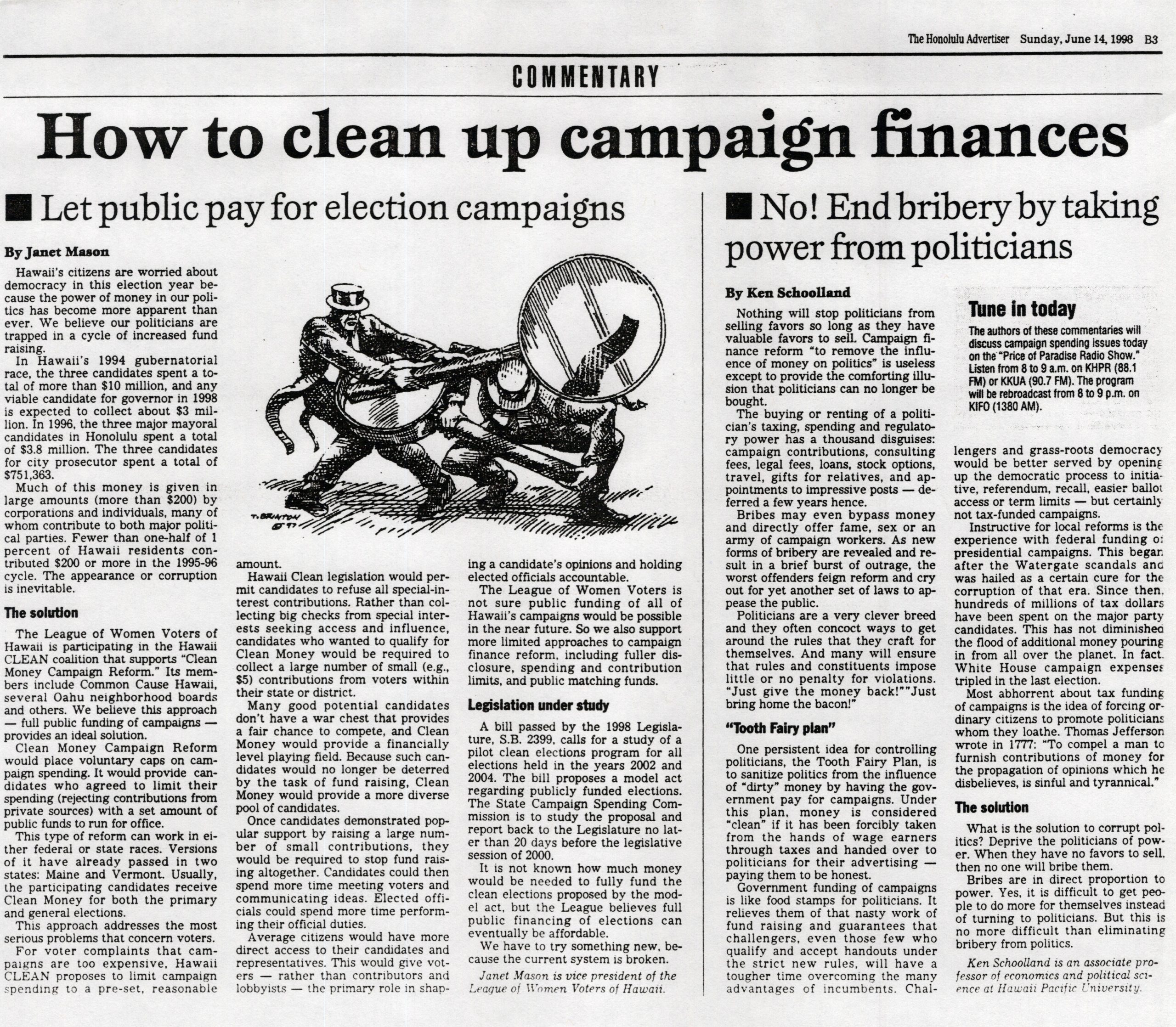
Two years after a 1996 Price of Paradise broadcast on the same subject, this June 1998 episode examined specific proposals for reforming Hawaii's campaign finance system. Janet Mason, vice president of the League of Women Voters of Honolulu, argued that money effectively determines electoral outcomes and proposed a voluntary Clean Money arrangement under which candidates who gathered a minimum number of small donations would qualify for modest public funding and agree to forego large private contributions. She cited research suggesting that when spending ratios stayed within two to one, incumbents and challengers competed on roughly equal terms. Ken Schoolland, a professor of economics and political science at Hawaii Pacific University, rejected the proposal as both ineffective and objectionable in principle, arguing that public funding compels taxpayers to finance political opinions they oppose; he preferred reducing the regulatory scope of government so that officeholders had fewer favors to sell. Bob Watada, executive director of the Campaign Spending Commission, described existing contribution limits and reported that the state's public election fund held roughly four million dollars that had gone largely unused. Whether a voluntary public financing system can meaningfully reduce the influence of private money in Hawaii's elections is the central dispute.
Transcript
Read or download the full transcript (.txt). Speaker labels were assigned automatically and may contain errors.
Companion newspaper commentaries
Commentaries by the guests, published in The Honolulu Advertiser around the broadcast.